

Power, Drawn
in Aluminium
At 43.3 metres and 38 knots, the Pershing 140 is the Italian yard's first superyacht rendered entirely in light alloy — a flagship built around the proposition that scale and adrenaline need not be a trade.
Every shipyard eventually reaches the moment when its own vocabulary is asked to grow up. For Pershing, that moment is 43.3 metres long, sheathed in aluminium, and travels at thirty-eight knots.
The Pershing 140 is the first all-aluminium superyacht the Italian yard has ever produced, and the first to emerge from the Ferretti Group's Super Yacht Yard in Ancona — the group's dedicated facility for steel and aluminium vessels above forty metres. She is, in other words, a structural argument as much as an aesthetic one: Pershing's DNA, translated into a category it had not yet occupied.
The authorship is worth pausing on. Fulvio De Simoni, who has drawn every Pershing line since 1985, worked alongside the Ferretti Group Engineering Department and the Strategic Product Committee led by Piero Ferrari. The result is a flagship that behaves — and looks — like a sports coupé translated into marine architecture: aggressive at the bow, disciplined along the flank, and uncompromising in its relationship with speed.
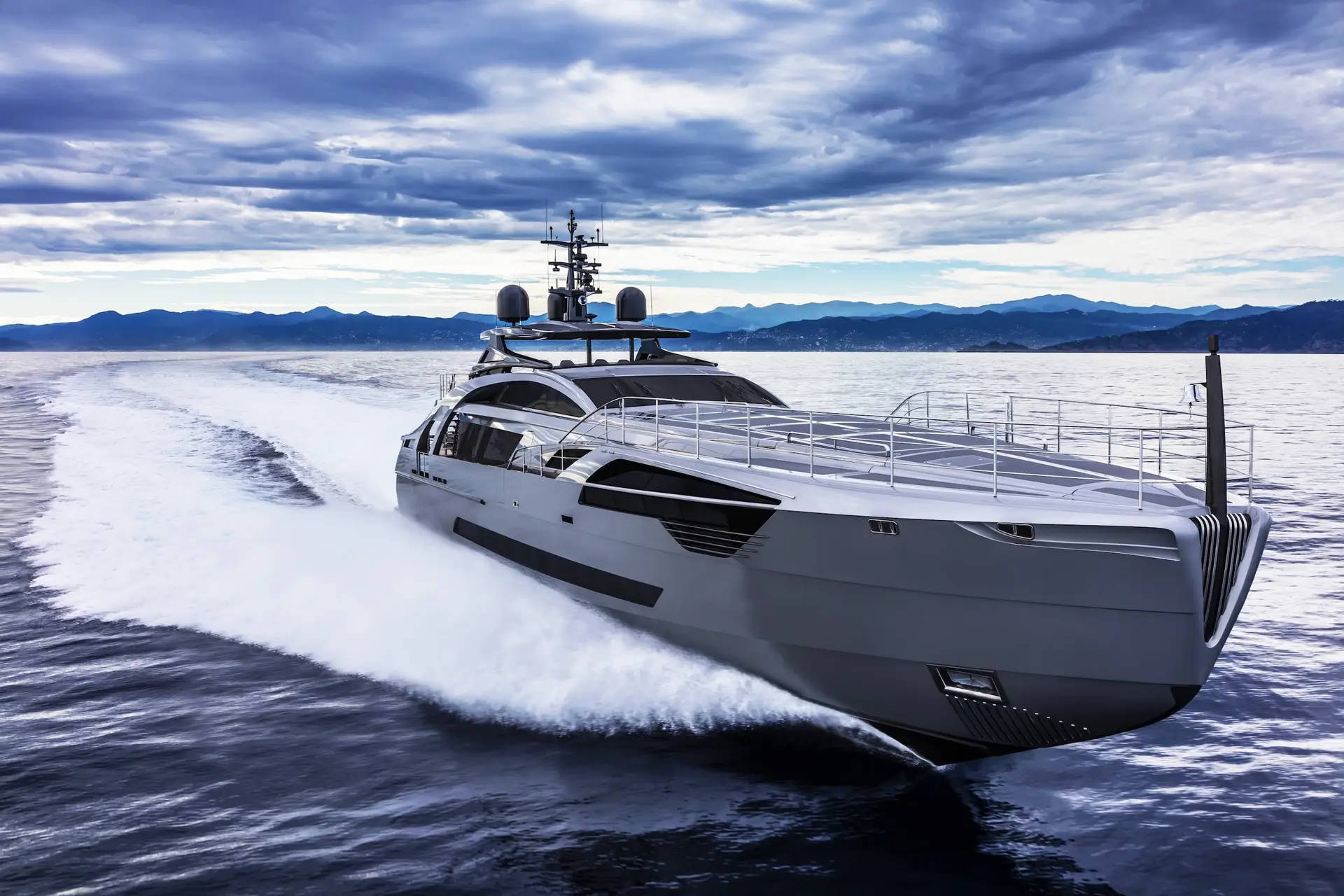
What makes the 140 exceptional is not that she is large. It is that she is large and fast, without either of those qualities taking the round off the other. The specification sheet reads like a brief deliberately drawn to deny compromise: four MTU diesels at 2,600 horsepower apiece, steerable and booster waterjets by MJP, a deep-V hull in light alloy, and a top speed of 38 knots in a vessel of 394 gross tonnes.
A sports coupé, scaled to the open sea
The 140's exterior makes no attempt to disguise its lineage. The bow carries the steel grille that De Simoni has described as his favourite element on the yacht — a detail that migrates, visibly, from Pershing's sports-flybridge language into a vessel more than forty metres long. The two side wings integrated into the superstructure at the start of the walkways are the brand's structural signature, and here they frame the aft deck as a private living room rather than a circulation zone.
The formal ambition is precise: the 140 should look fast while stationary, and behave like a coupé underway. The proportions serve that brief. The profile rakes forward, the superstructure closes on itself, the hard-top reads as a continuation of the sheer line rather than an addition. And the cockpit is drawn as a raised, mezzanine-level space that resolves the aft into a single vertical gesture from waterline to sun deck.
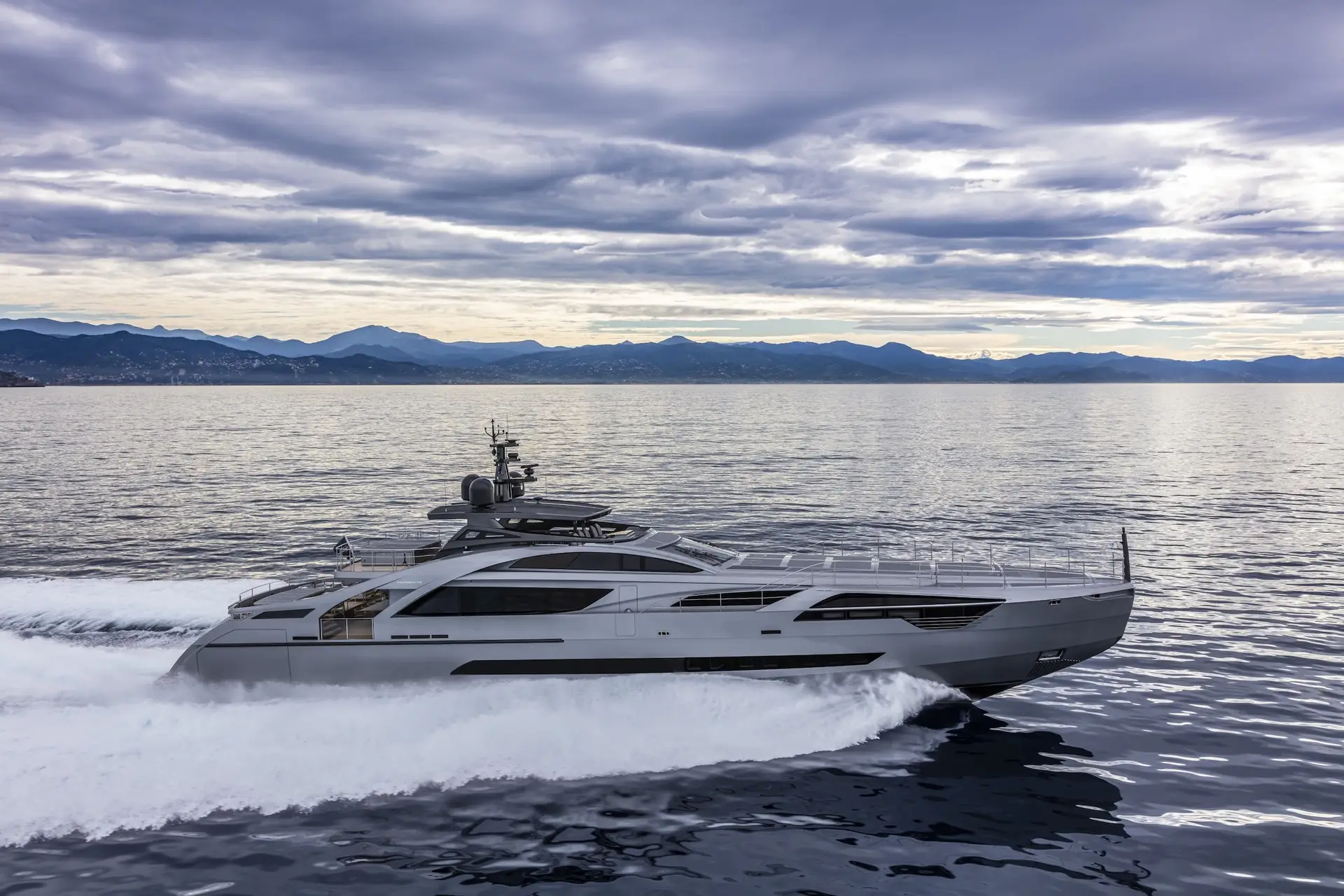
The ideal boat for those who, in everyday life, give up a cozy sedan for a beautiful sports car.
Fulvio De Simoni · On the Pershing 140Three firsts that reframe the flagship
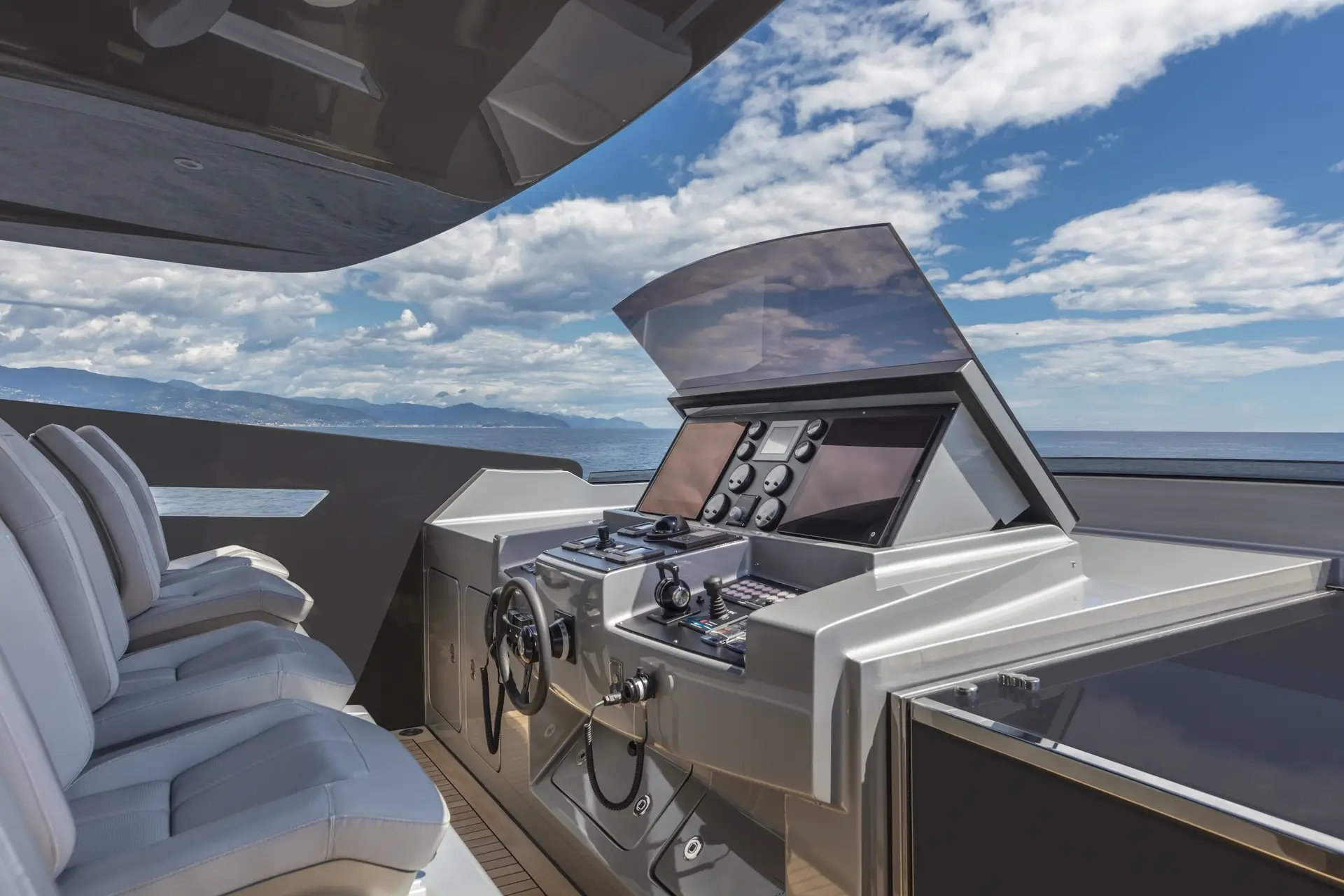
The 140 is the first Pershing with a raised helm station connected directly to the sun deck above, collapsing the distance between the captain's position and the yacht's most social terrace. The layout can be extended with a bar, sunpad and second helm — a command post that doubles as a lounge.
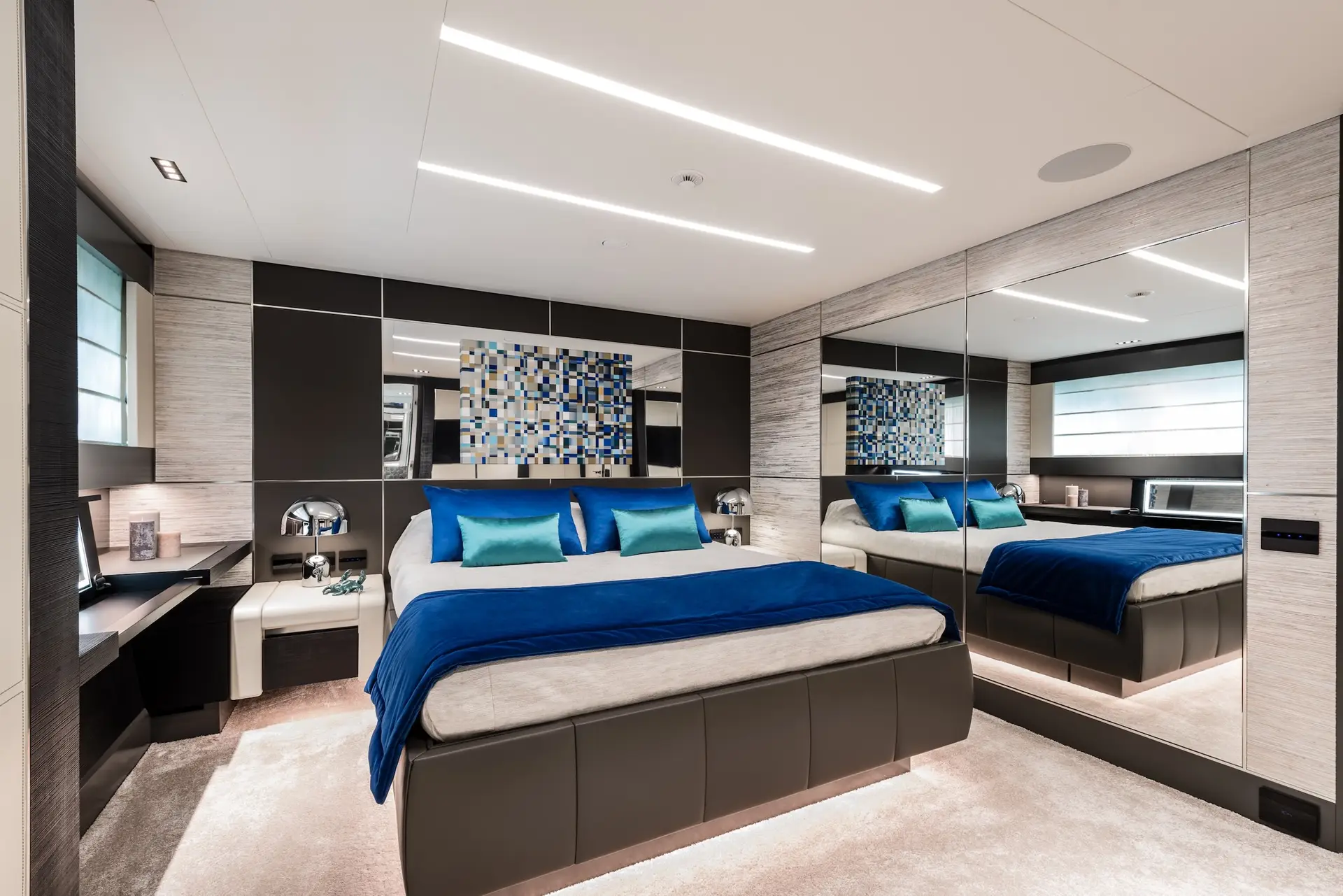
Also a first for the yard: a dedicated owner's area forward on the main deck, built around a private study and sitting room, a generous dressing area, and a bathroom finished in mosaic and mother-of-pearl lacquer. On the maiden hull the owner converted the space into a private entertainment room.
Aft of the engine room, the beach club unfolds with fold-down terraces on both flanks and a sliding swim platform astern — a waterside room that more than trebles in footprint when at anchor. Inside the garage, a Williams tender and two Sea-Doo jet skis are launched through two side hatches.
A living room written in white lacquer
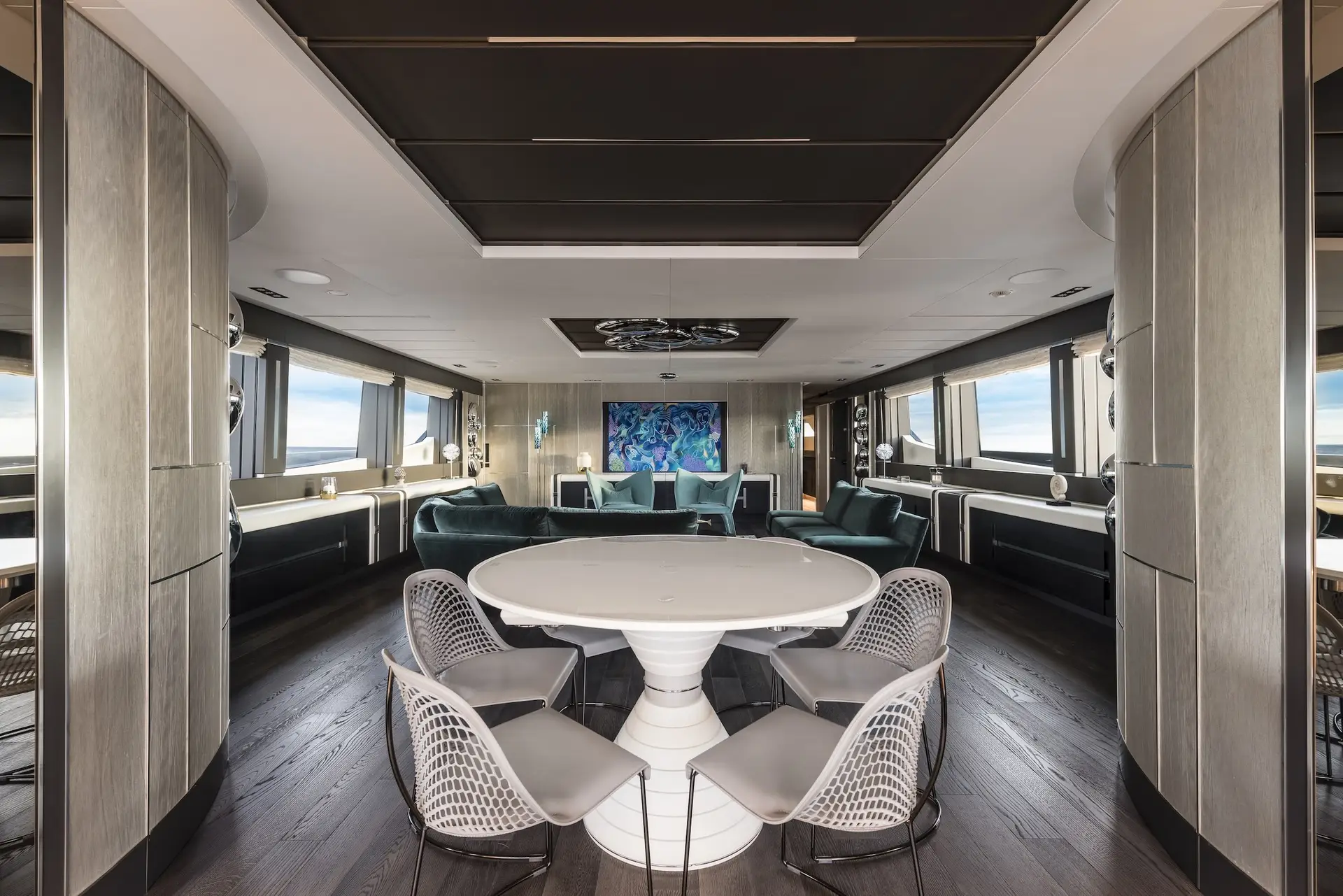
The main salon is where the 140's sporting geometry softens into domestic precision. Oversized glazing widens the field of view; white lacquer and mirrored detailing pull the light through the full length of the space; the transition to the cockpit reads as a single gesture rather than a threshold.
The aft bar on the starboard side is built as a structural unit with its own lighting, concealed behind textured-lacquer panels that match the salon's finish. The room absorbs the bar when it isn't in use and produces it, intact, when it is — the kind of detail that rewards living aboard rather than merely visiting.
An Italian vocabulary in lacquer, mirror and lead-grey wood
White lacquer, lead-grey wood, and a softer Pershing
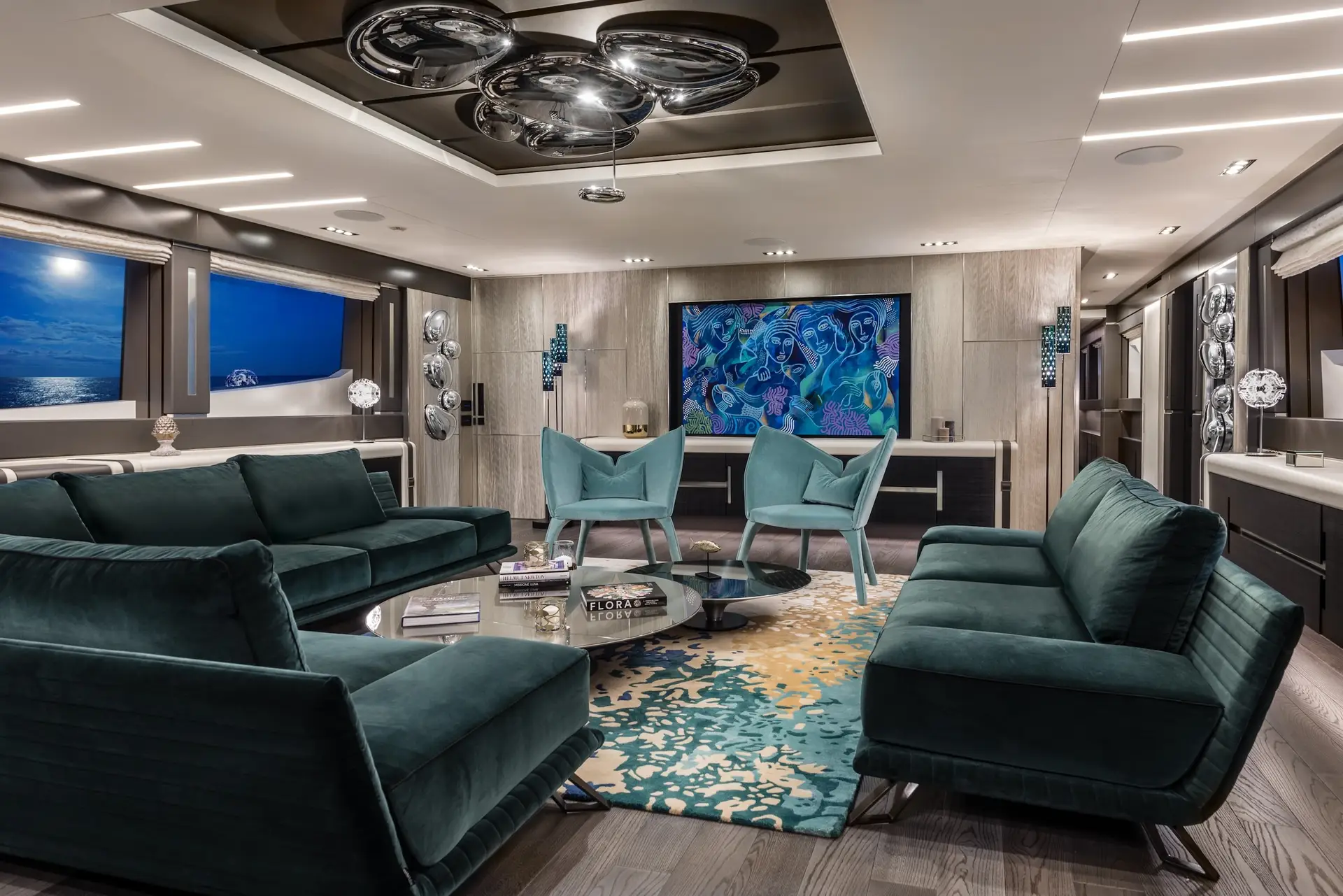
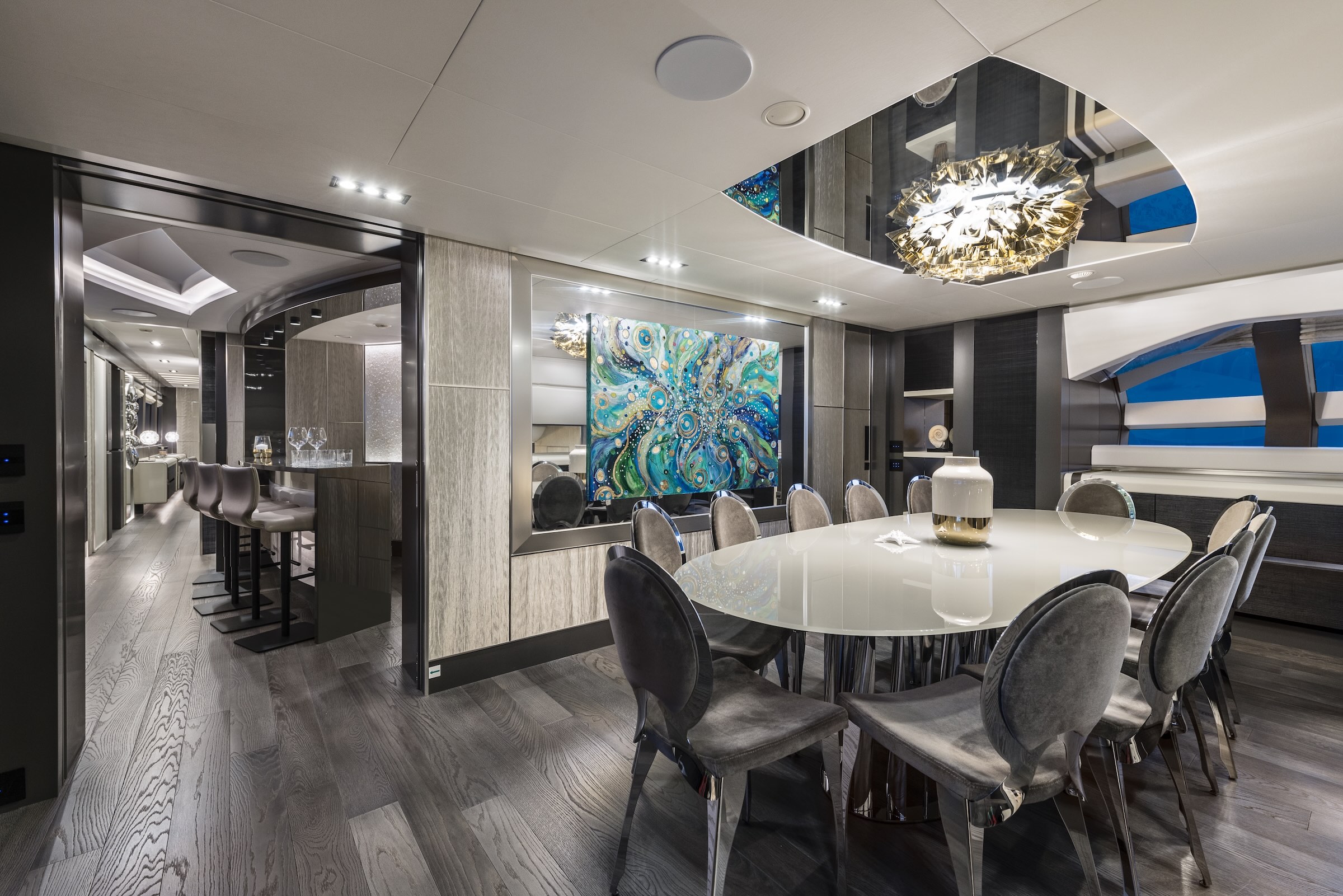
The interior brief on this hull is quieter than Pershing's historical register. White lacquer carries the bulk of the space, deliberately paler than earlier 140 units. It is paired with lead-coloured wood — a pale grey that resolves the warmth of the lacquer into something closer to light atmosphere than to cabinetry — and with mirrored surfaces arranged to deepen the impression of volume.
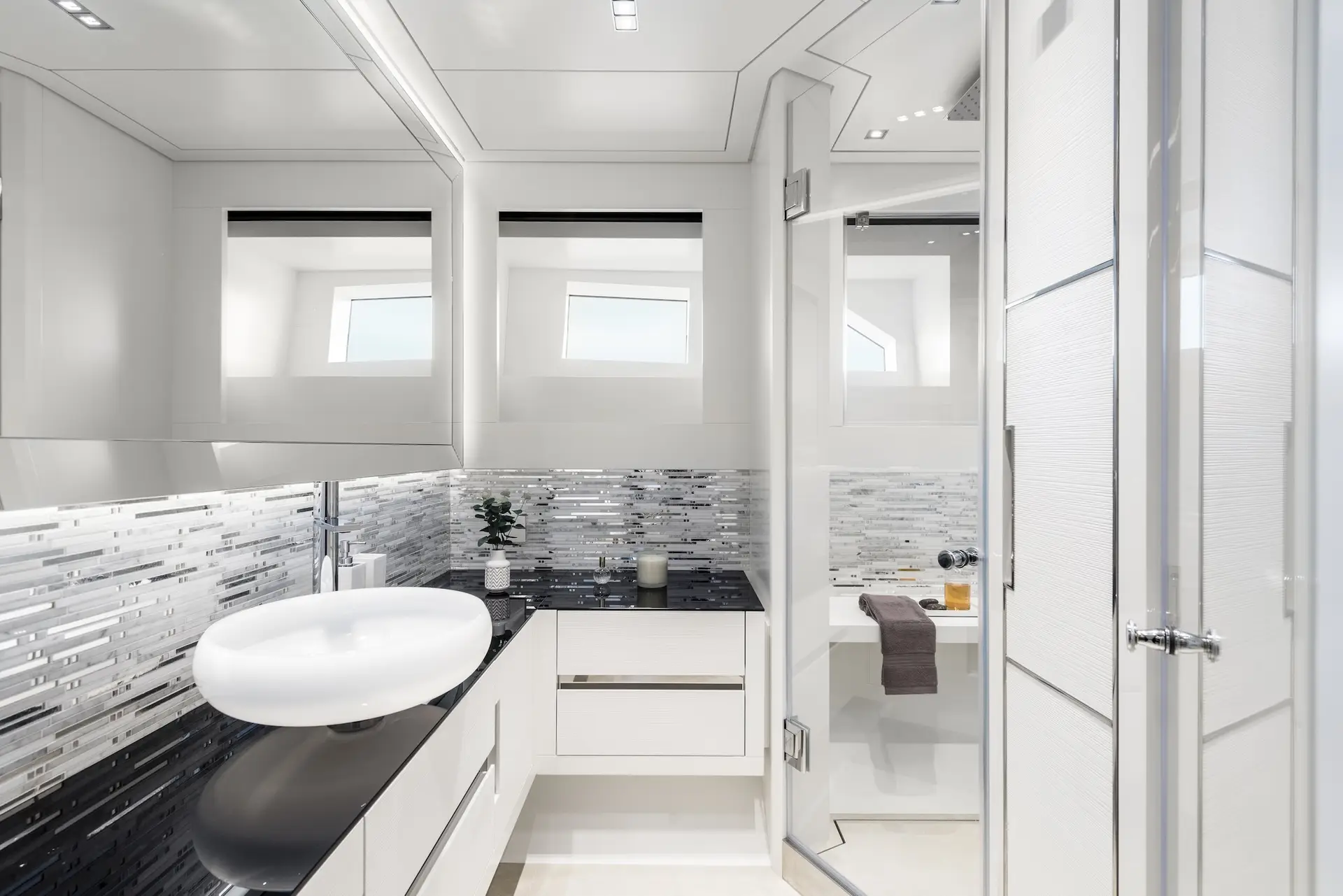
The furnishing credits read as an index of Italian design. Poltrona Frau, a longstanding Pershing collaborator, anchors the upholstery; Minotti, Roche Bobois, Molteni, Artemide and Fontana Arte contribute furniture and lighting. The bathrooms, across the yacht, are finished in mosaic tile and a mother-of-pearl lacquer that catches the light as a textile would.
Pershing 140 slices through the sea with all the elegance of a gleaming blade.
Pershing · On the yard's first aluminium flagship
Four MTUs, four waterjets, one argument
The 140's powertrain is the part of the brief that never negotiated. Four MTU 16V 2000 M96L diesels deliver 2,600 horsepower apiece for a combined output of 10,400 hp, pushing a deep-V aluminium hull to a top speed of 38 knots and a cruising speed of 35. Propulsion is by MJP waterjets in a four-unit arrangement — two steerable drives for manoeuvre, two booster units for top-end thrust — paired with ZF gearboxes. The fuel tank carries 26,000 litres; at an economical ten knots, that yields a range of 1,400 nautical miles.
The hull is a deep-V in light alloy, a platform Pershing's engineering team studied extensively — including against military references — to hold performance above thirty knots without surrendering comfort beneath. The result is an aluminium shell drawn to displace as little as possible at speed, balanced by a triple-stabiliser array of three Seakeeper 35 gyros and Humphree trim tabs that hold the yacht steady both underway and at anchor. Draft, at roughly 2.05 metres, keeps the 140 useful in shallow coastal water that most vessels of this length cannot reach.
Ten guests, seven crew, five suites
The layout accommodates up to ten guests across five cabins, with a full-beam owner's suite on the main deck and four further cabins on the lower deck — two with king beds, two with twin berths, all with private bathrooms. The owner's suite carries a private study on entry, a walk-in dressing area, and a bathroom divided between a steam shower and a separate bathtub.
Crew service is arranged for up to seven in discreetly accessible quarters reached through the engine room. A professional galley sits to port, with a dinette aft, reflecting a shipyard brief that treats extended voyages and chef-on-board dining as defaults rather than options.
At a glance
The 140, placed in the Pershing line
What the Pershing 140 has done, quietly, is enlarge the yard's definition of itself. The brand spent three decades drawing sport-flybridge coupés up to the 115; the 140 pushed the vocabulary into the superyacht tier without softening the tone that made Pershing recognisable in the first place. The sports-car grille is still there. The aggression is still there. What is new is the scale at which those elements are now asked to behave.
The production run is small by design. Five hulls have been built, the last of them — Arina, delivered in 2024 — now entering the brokerage market at around €26 million. That rarity is not incidental; it is the shape of the argument. The 140 was never going to be a volume product. She was going to be the yard's most explicit proof that an all-aluminium superyacht could carry the brand's sporting DNA at forty-three metres without translating it into a different language along the way.
Seen from that angle, the specification sheet stops reading like a list and starts reading like a thesis. Four MTUs, four waterjets, a raised helm wired to the sun deck, a beach club that opens on three sides, and a full-beam owner's apartment that the brand has never built before. Power, drawn in aluminium, is the line the 140 writes — and the flagship that now holds it.
A visual tour through the flagship
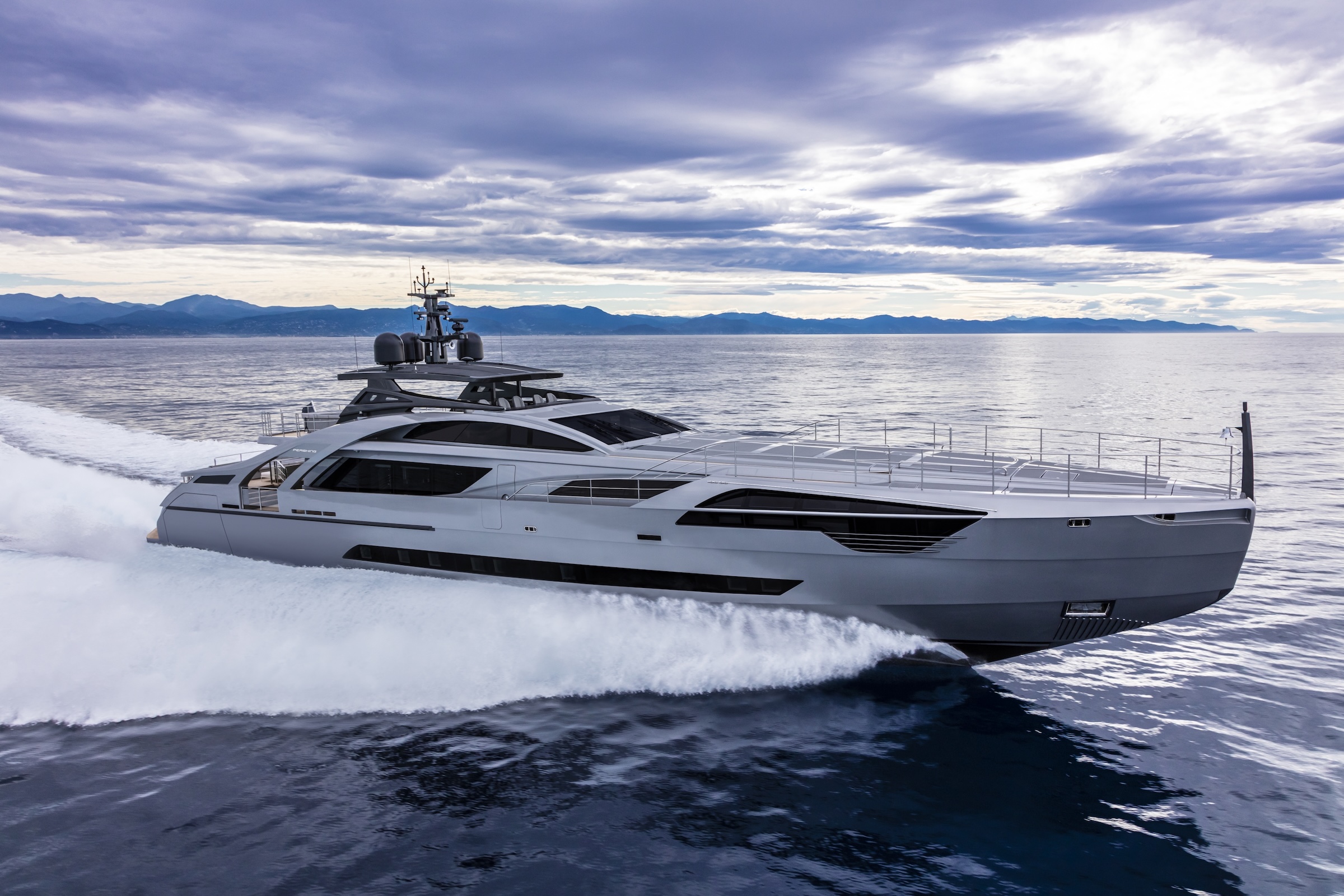 01 · Underway
Full power
02 · Profile
Three-quarter starboard
03 · Parallel
Cruising profile
01 · Underway
Full power
02 · Profile
Three-quarter starboard
03 · Parallel
Cruising profile
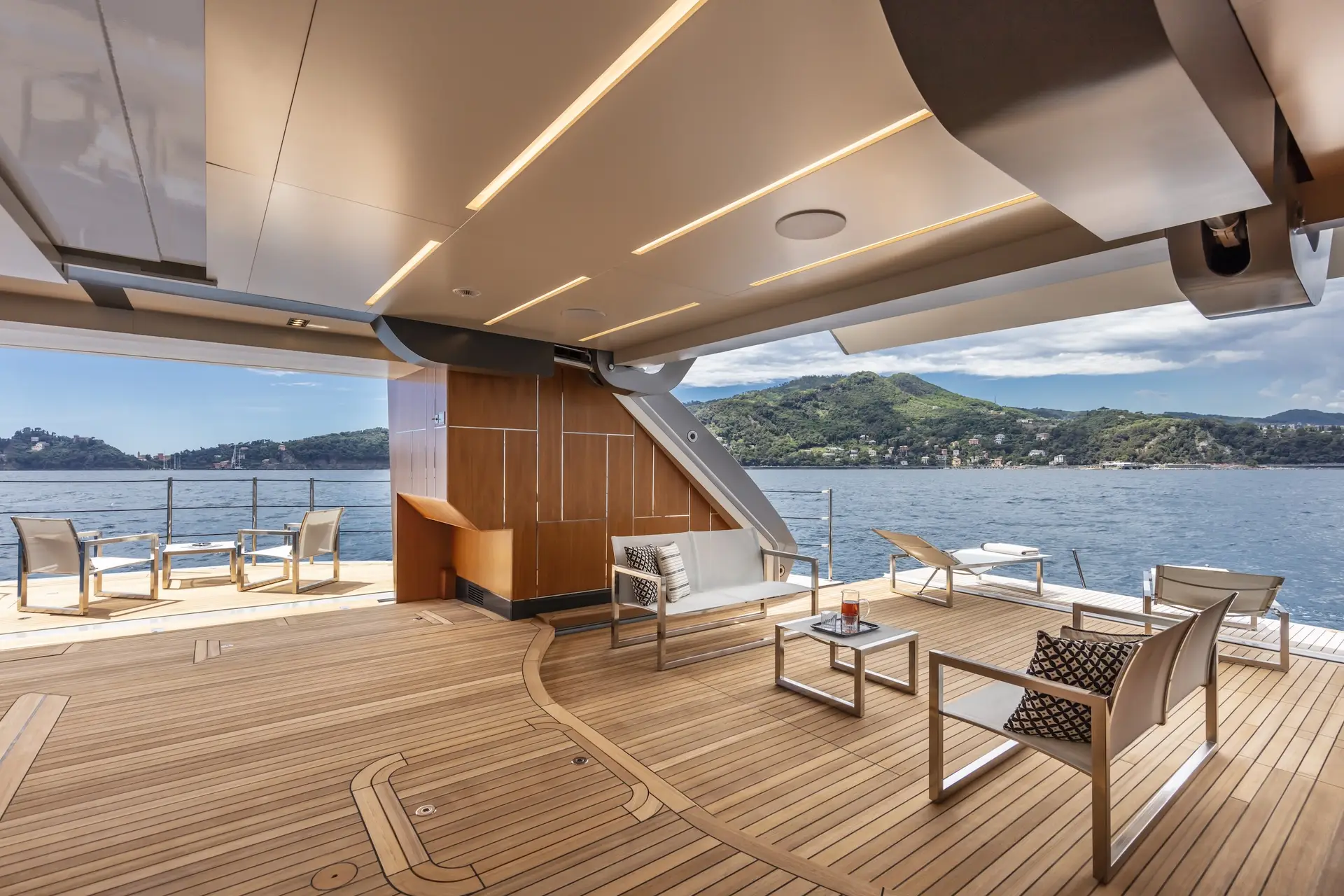 04 · Stern
Salon open to sea
04 · Stern
Salon open to sea
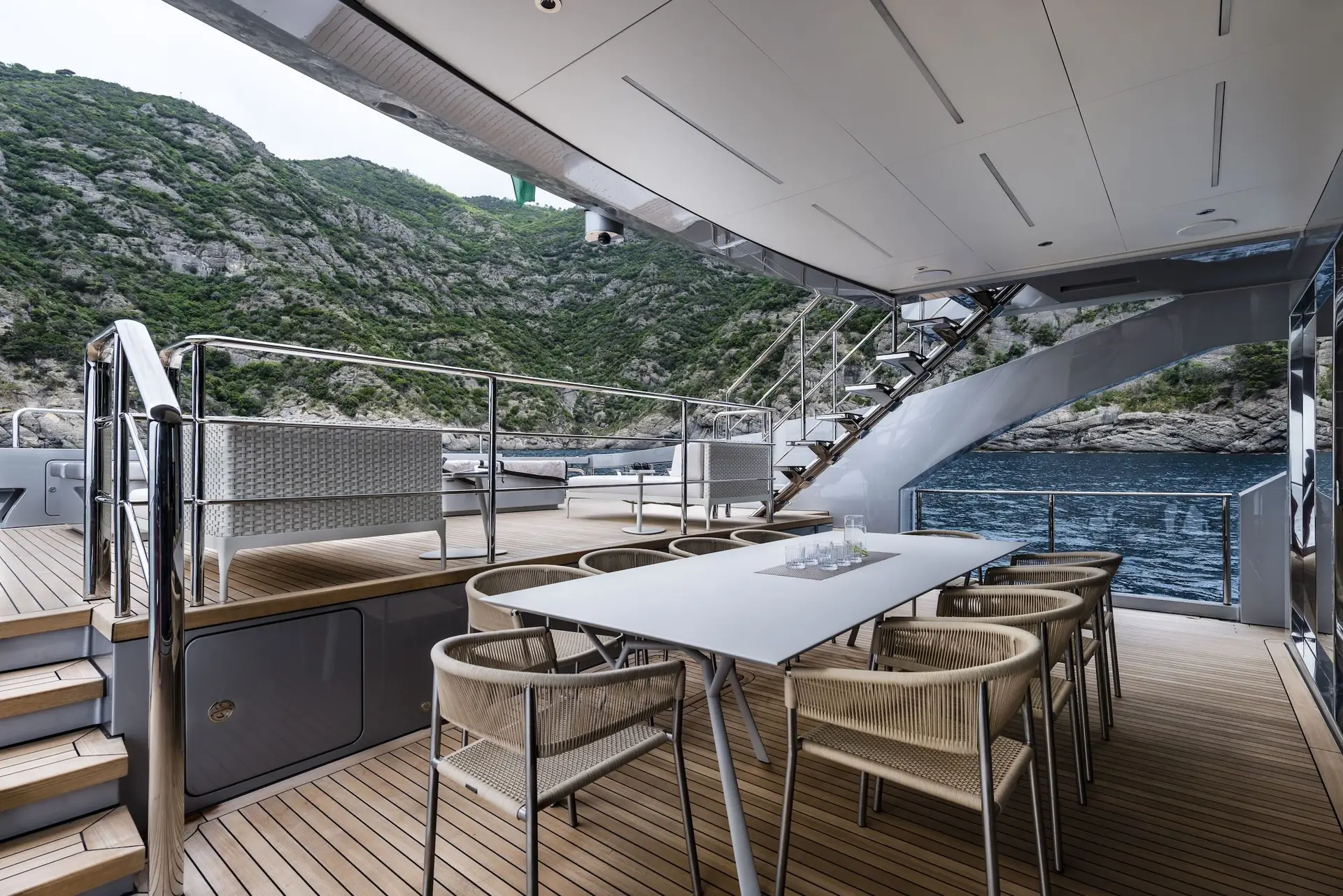 05 · Cockpit
Al fresco dining
05 · Cockpit
Al fresco dining
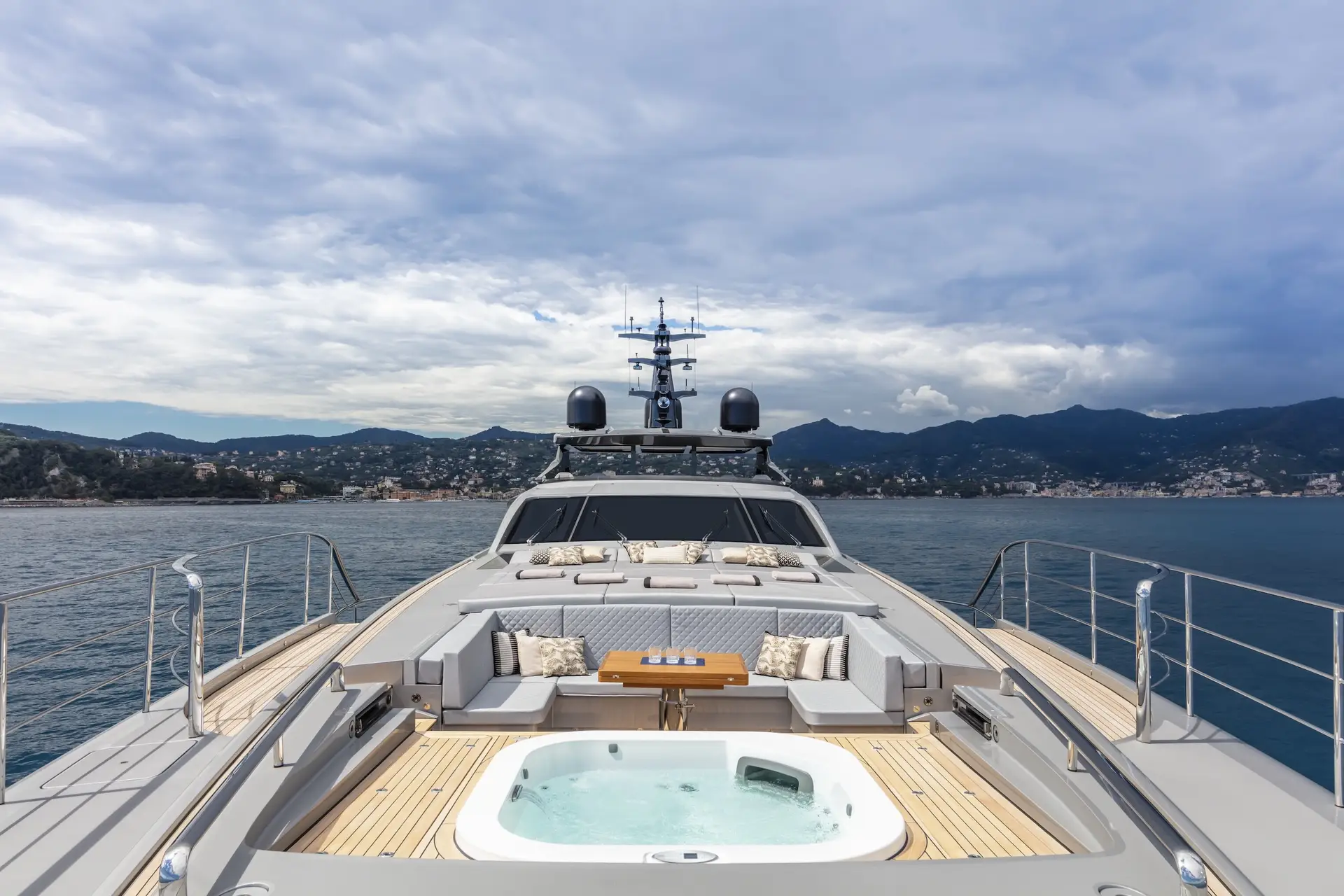 06 · Bow
Sun chairs · Jacuzzi
07 · Salon
From the entrance
08 · Glazing
Panoramic view
09 · Dining
Formal setting
06 · Bow
Sun chairs · Jacuzzi
07 · Salon
From the entrance
08 · Glazing
Panoramic view
09 · Dining
Formal setting
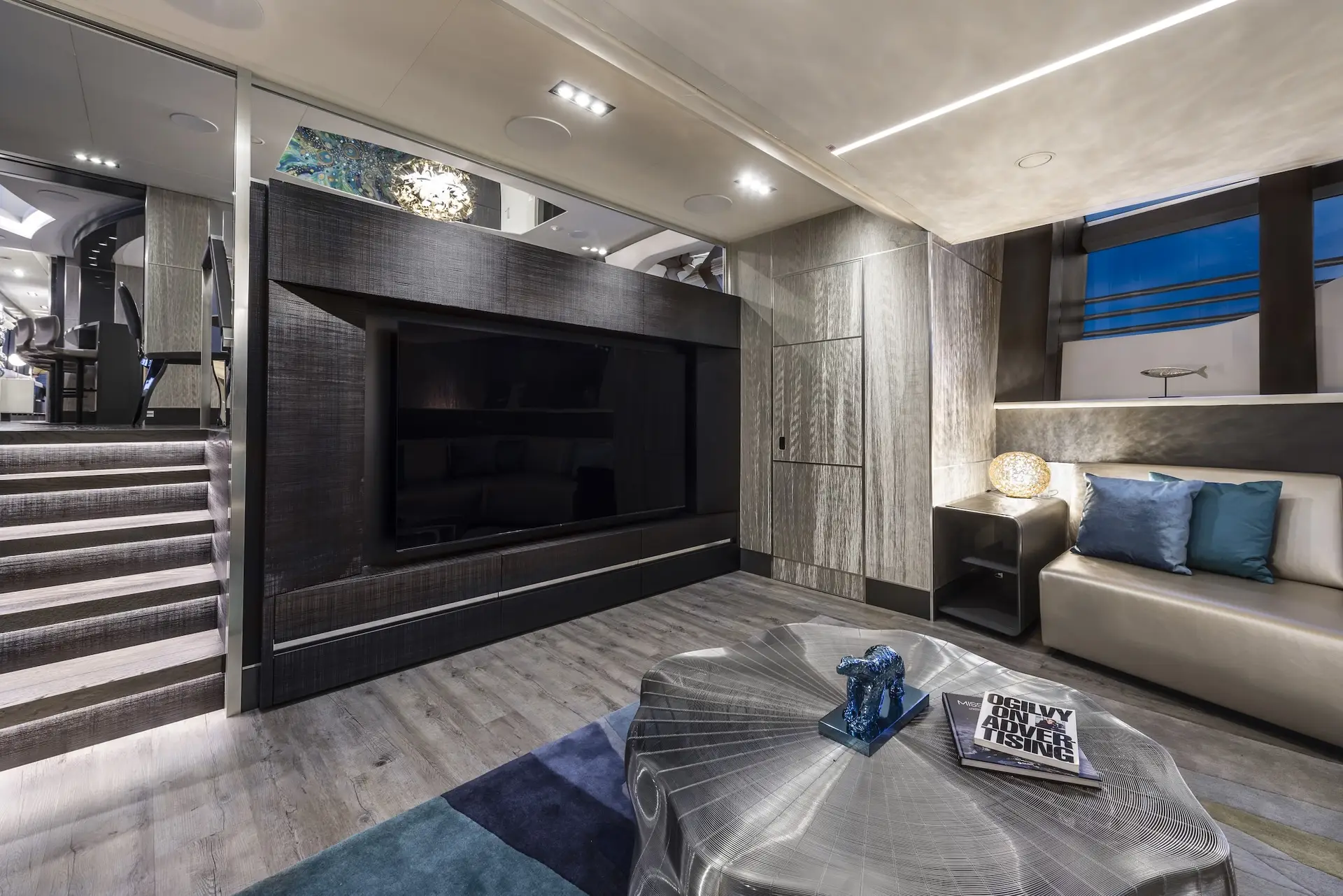 10 · TV Room
Entertainment
11 · Master
Full-beam suite
12 · Bath
Owner's ensuite
13 · Flybridge
Helm · Controls
10 · TV Room
Entertainment
11 · Master
Full-beam suite
12 · Bath
Owner's ensuite
13 · Flybridge
Helm · Controls
A 43-metre aluminium flagship that runs at 38 knots without softening a single Pershing line — the yard's sporting DNA, translated into a category it had not yet occupied.