


Simena
The Long Sentence
A 62-metre ketch built in steel and carbon, drawn around a clipper bow and a sweeping sheerline, the ARES Simena is the largest sailing yacht ever designed and built in Türkiye — and the most articulate argument yet that the country has crossed into the upper register of the global sailing-superyacht market.
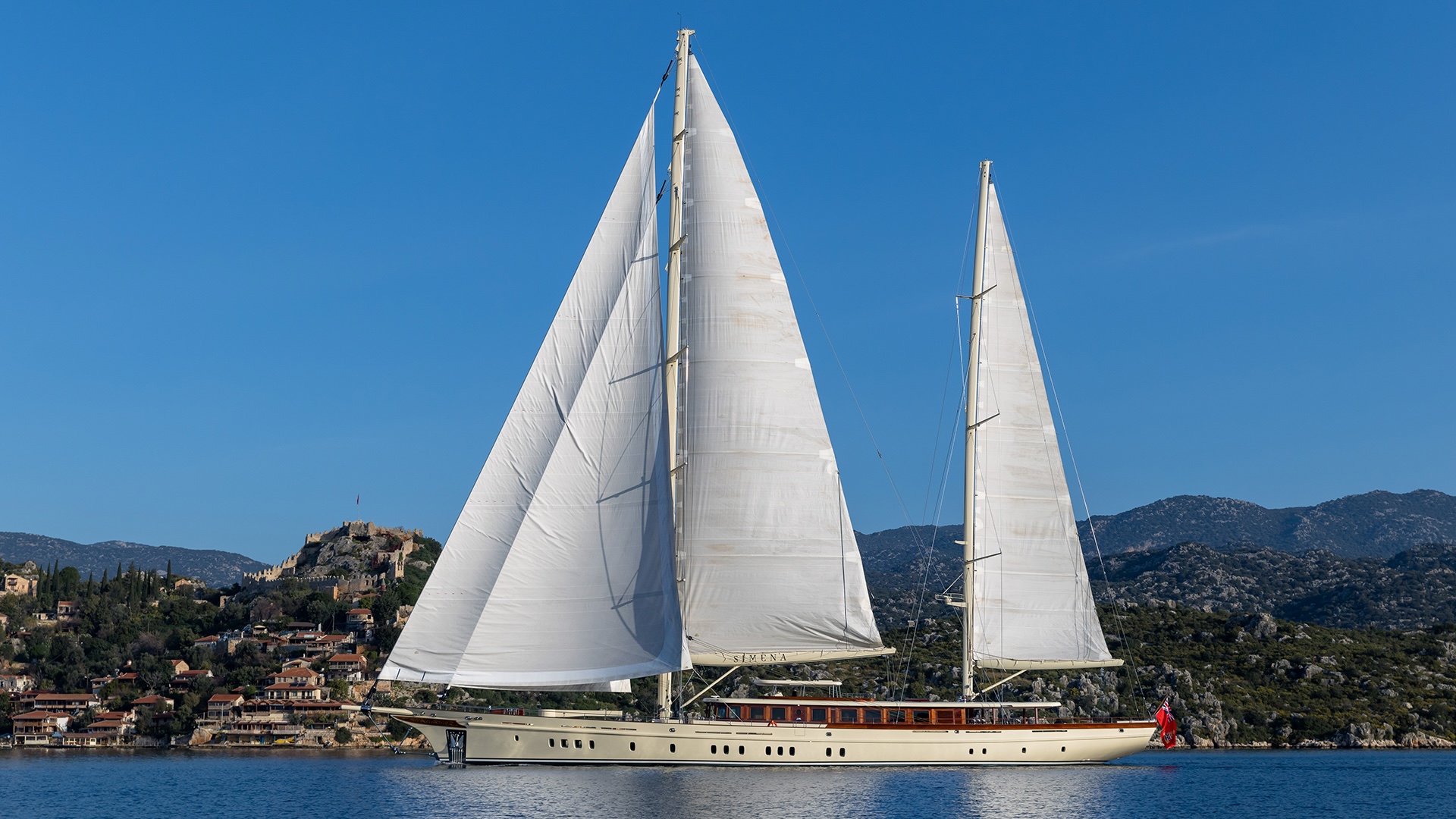
There is a particular silhouette a ketch makes against a horizon — two masts, one distinctly taller, a long sheerline, the small overhangs of a more patient century — and the eye recognises it before the mind catches up. Simena, the new flagship from ARES Yachts, is built around that recognition.
Launched in Antalya and now circulating the Mediterranean ahead of her world debut at the Palma International Boat Show, the 62-metre ARES Simena sailing yacht is the first vessel in the 60-plus-metre range from a yard better known for fast patrol craft and high-spec commercial builds. She is also the largest sailing yacht ever both designed and built in Türkiye — a record drawn in steel and carbon by a country that, until very recently, was not part of the conversation about superyacht sailboats at all.
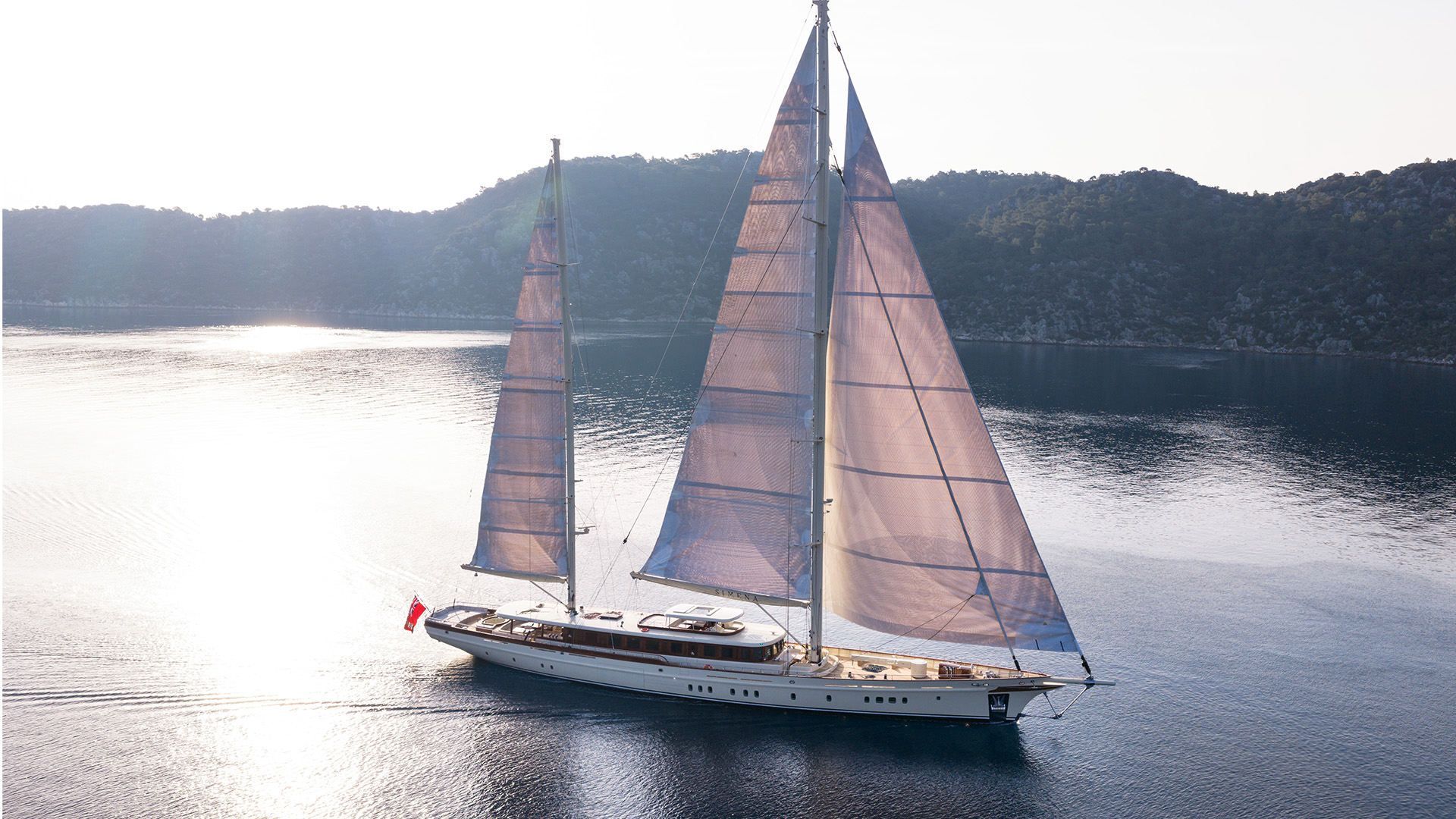
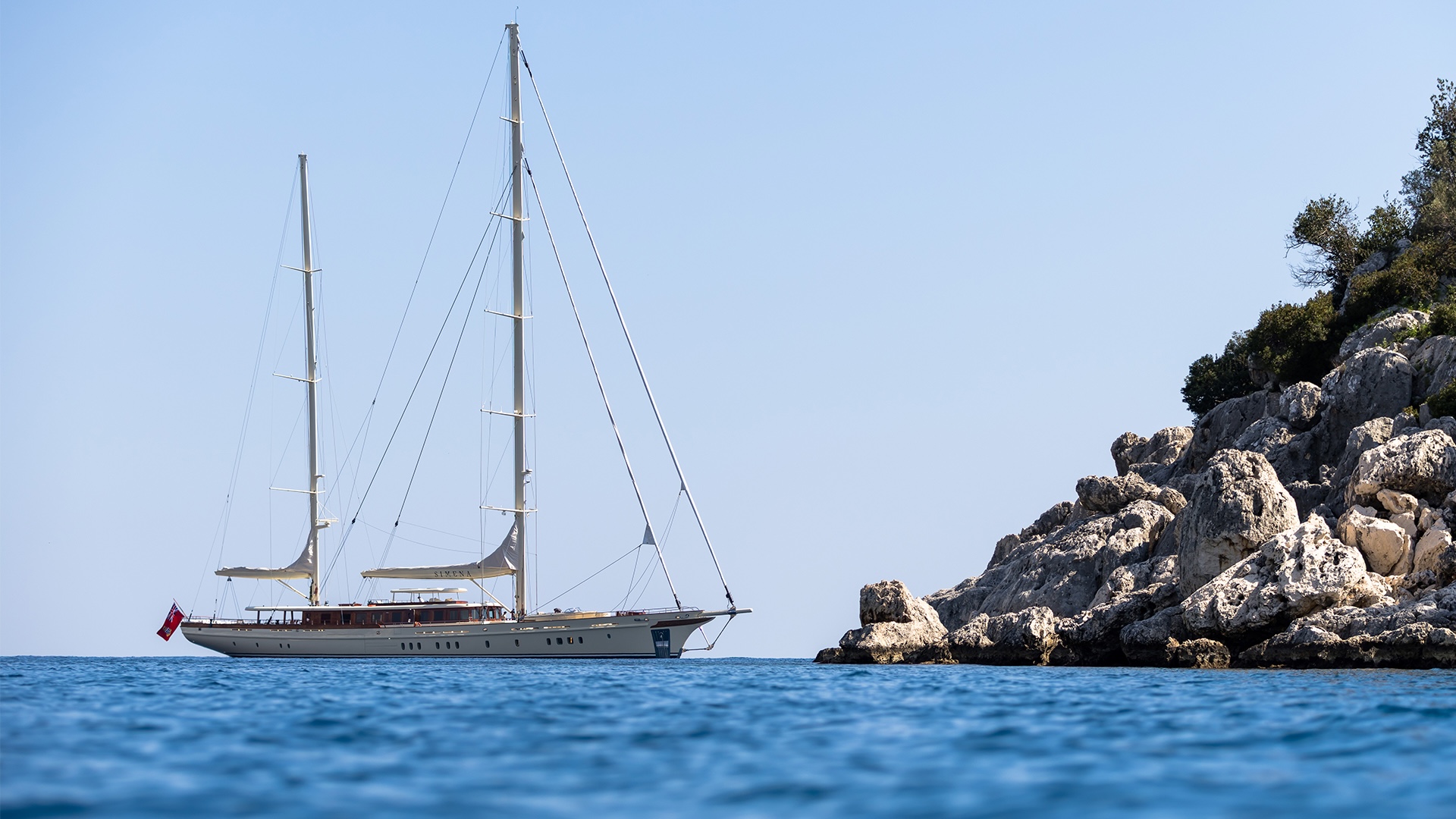
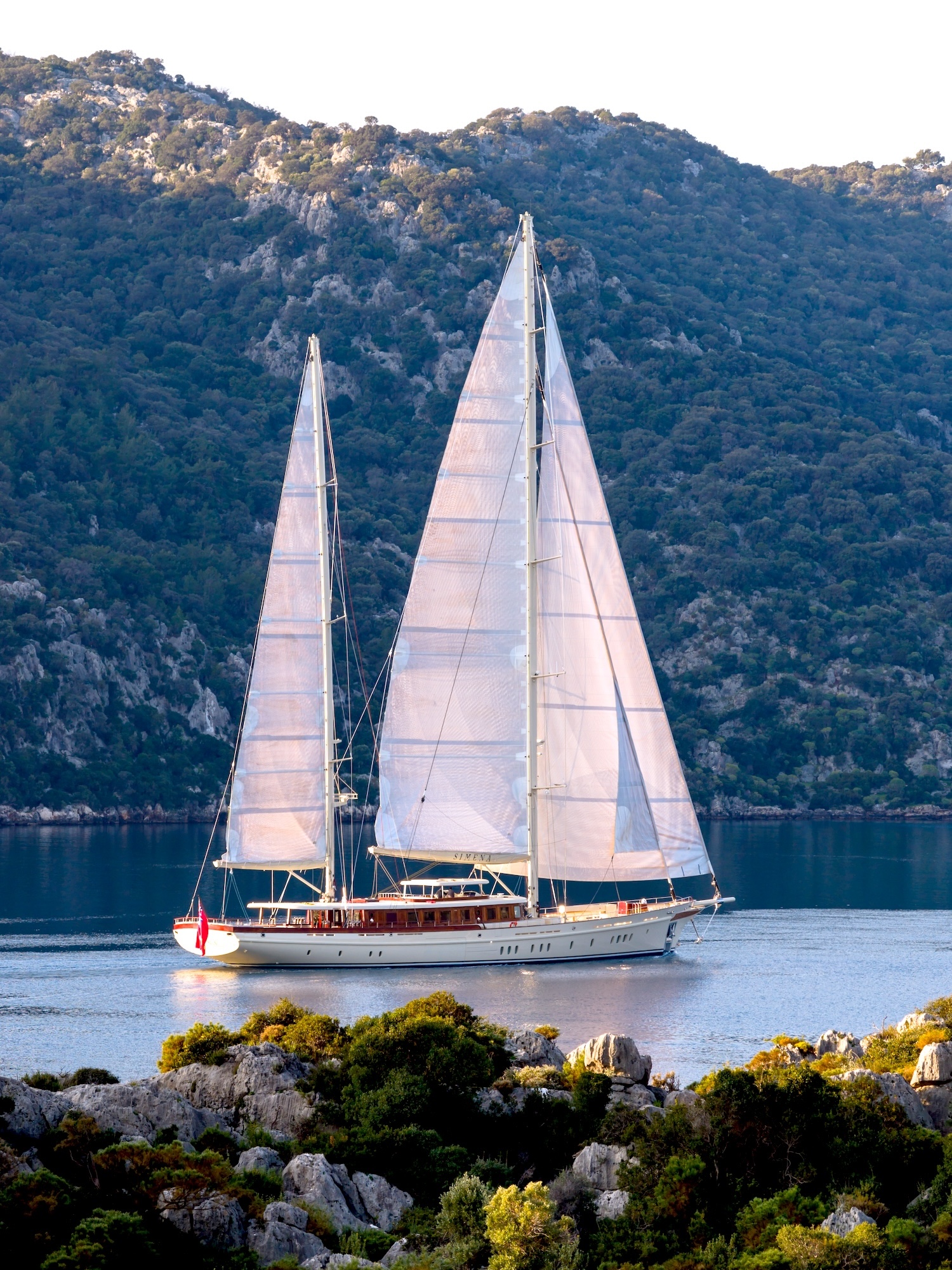
The brief, given to Istanbul-based Taka Yacht Design, was to evoke and update traditional yachting forms without slipping into pastiche. The result is a ketch with a distinctive clipper bow, twin headsails reminiscent of a cutter rig, and the modest overhangs of an older school of yachting — proportions associated with what Taka's founder Tanju Kalaycıoğlu has described, in his own work, as "classic with character." The mainmast climbs 59 metres above the waterline. The mizzen still reaches 48.
What's beneath the waterline is a different argument entirely. A modern hull form, appendices tuned for performance, a steel hull engineered to AH 36 spec, and a composite superstructure of glass, carbon and epoxy foam — designed to lower the centre of gravity and, with it, the motion at sea. The interior, by Hampshire-based Design Unlimited, completes the case: a contemporary translation of golden-era yachting, where varnished sipo mahogany sits next to antiqued brass and Turkish stone in the bathrooms. The whole vessel is engineered, classed and marketed as a serious global cruiser. She is also, by some margin, the most considered first-flagship a yard has launched in the segment in years.
A clipper bow drawn for the twenty-first century
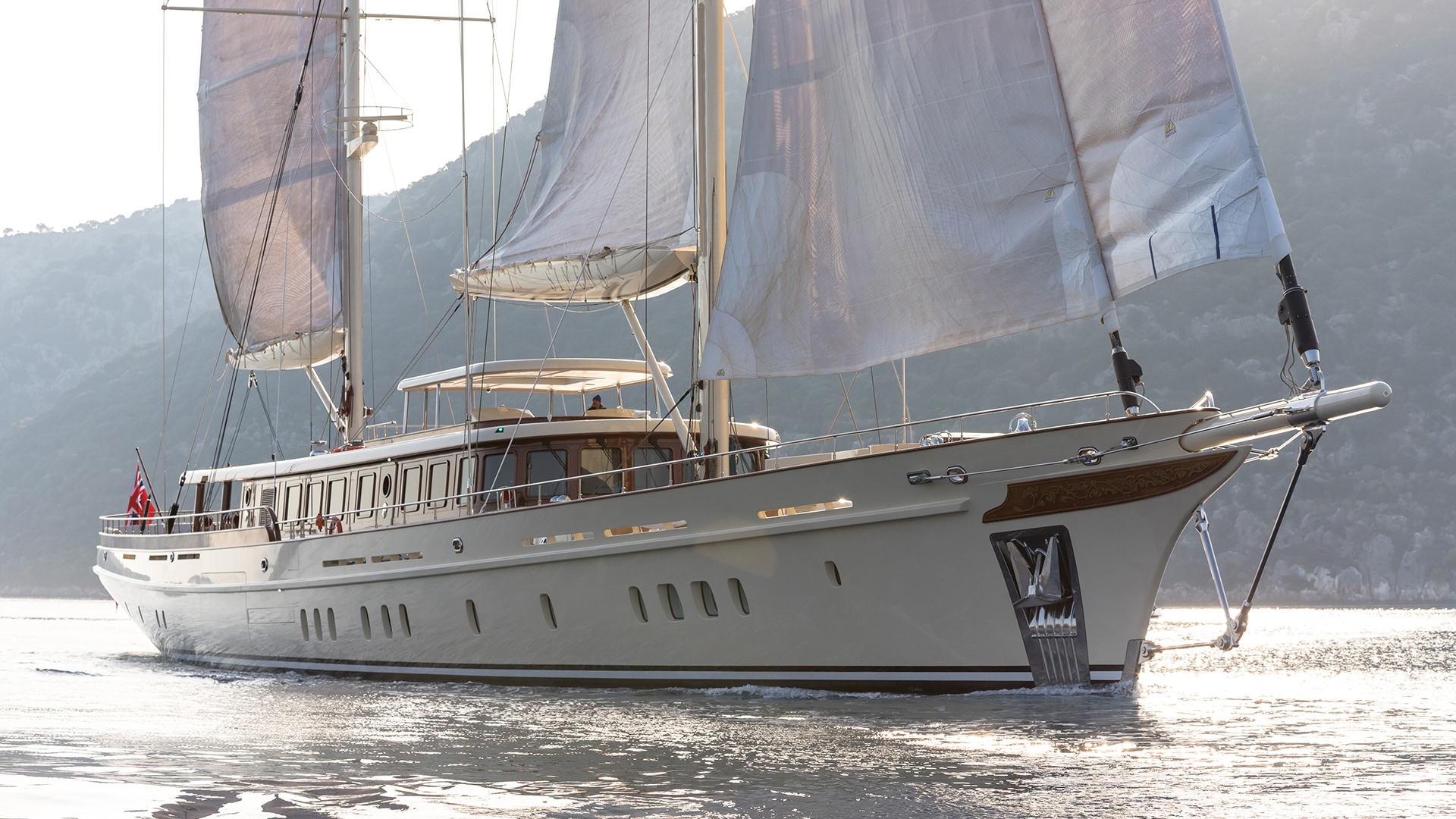
The first thing the eye does, looking at Simena, is travel along her sheerline. It is not flat, in the modern manner, and it is not exaggerated, in the gentleman-yacht manner. It sweeps — gently, deliberately — toward a forward bowsprit and a clipper bow with full trail board, the kind of detailing that connects the boat to a much earlier century of sailing. Twin headsails sit on the bowsprit in a configuration borrowed from the cutter tradition, while the modest overhangs at bow and stern read more like a 1930s gentleman's yacht than a 2026 superyacht.
All of which would be a costume, if it stopped there. It does not. The hull form below is unambiguously modern — refined for performance, with appendices optimised for upwind and reaching angles, and a fixed keel carrying 90 tonnes of ballast against a 570-tonne displacement at full load. The steel hull, built to AH 36 marine grade, is paired with what is, according to her brokers, the largest composite superstructure on a sailing yacht of this type to date. Glass, carbon and epoxy foam combine to lower the centre of gravity, sharpen the response, and quiet the structure underway.
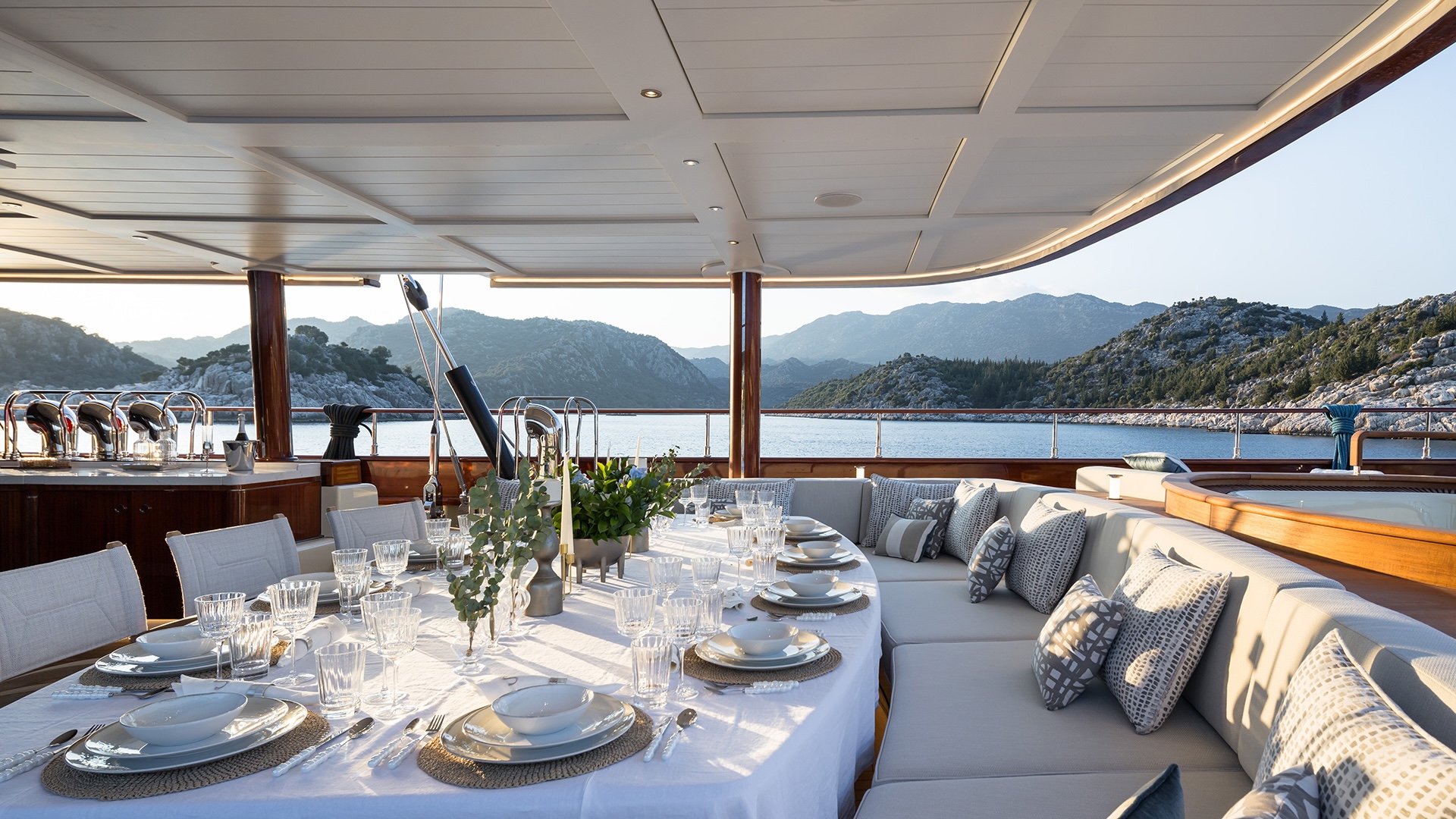
Above deck, the language is restrained. A low-profile flybridge sits sunken into the superstructure behind a slim mahogany coaming, contributing, as Taka has put it, almost nothing to the visible bulk. Wide side decks lead forward to a foredeck lounge between wheelhouse and mainmast. There is brightwork — the sipo mahogany barnished trim, the brass detailing — but it is held in tension with stainless steel fittings, neutral upholstery, and the kind of foldable, gleaming-frame armchairs that read as contemporary rather than nostalgic. The yacht is not pretending to belong to another century. It is borrowing from one.
Classic with character — the DNA borrowed from earlier wooden ketches, scaled up.
Tanju Kalaycıoğlu · Naval architect · Taka Yacht DesignA ketch built around three deliberate gestures
Three 86 kW CAT generators, an 882 hp MAN diesel and a 220 kW electric motor combine into a propulsion system that switches between diesel, electric, combined and regeneration modes. In sailing mode, water flowing past the propeller generates electricity from around 7 knots of boat speed — running every system on board without firing a generator.
All by Doyle Sails: 470 m² mainsail, 249 m² mizzen, 596 m² genoa, 356 m² staysail. Seven captive winches sit hidden below deck, with custom Antal hardware on deck for raising, reefing and furling. In sea trials, the yacht reached 16 knots in 20 knots of true wind at a 100-degree angle — a number that takes the boat seriously.
In electric mode, drawing from the generators, Simena manoeuvres in near silence at up to 7.5 knots with a transoceanic range of more than six thousand nautical miles. For higher speeds — up to 14 knots — the MAN engine engages with a power take-off that runs the navigation, climate and hotel loads simultaneously. A serious global cruiser, sketched as one.
A warm, almost clubby ambience
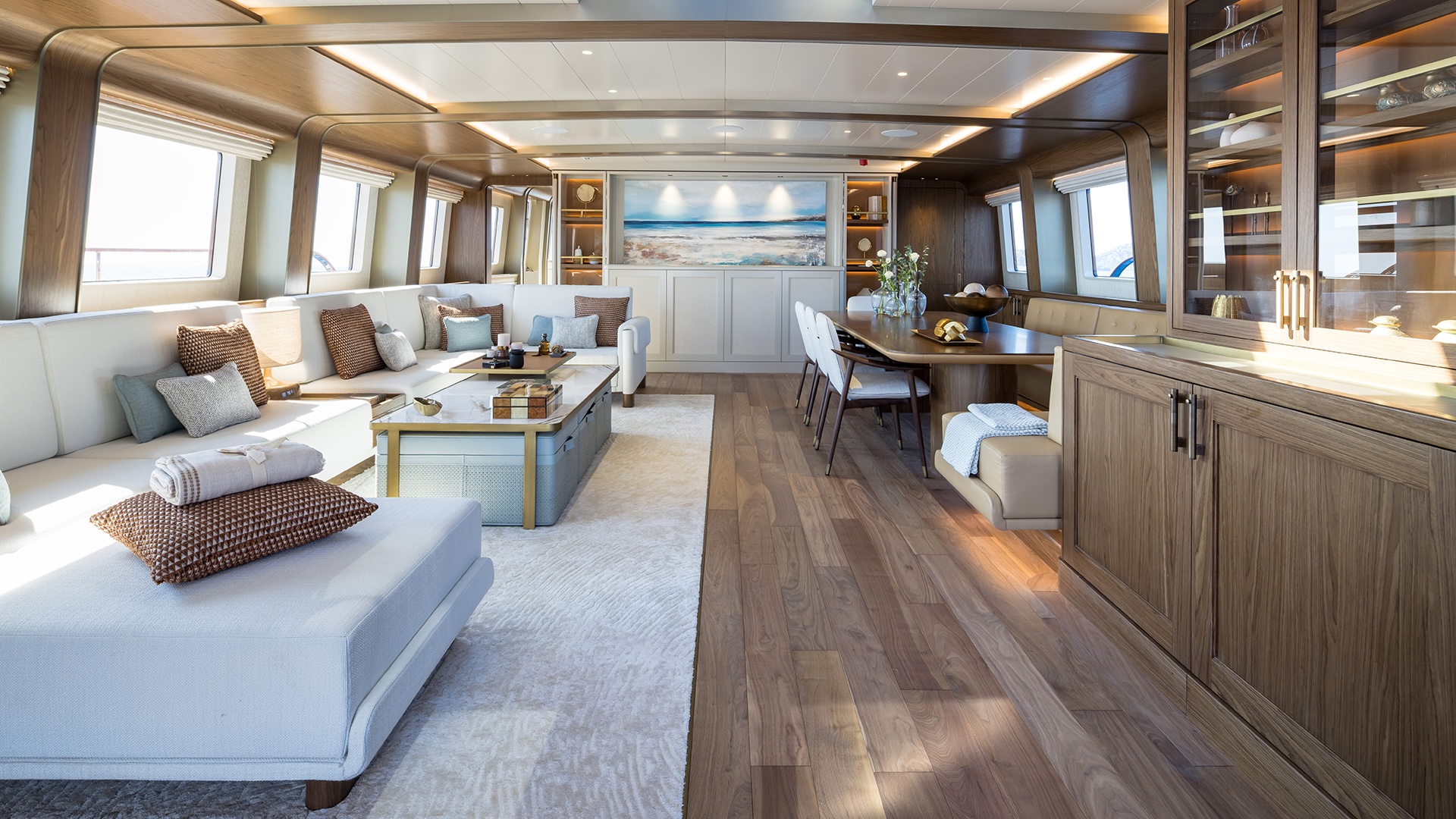
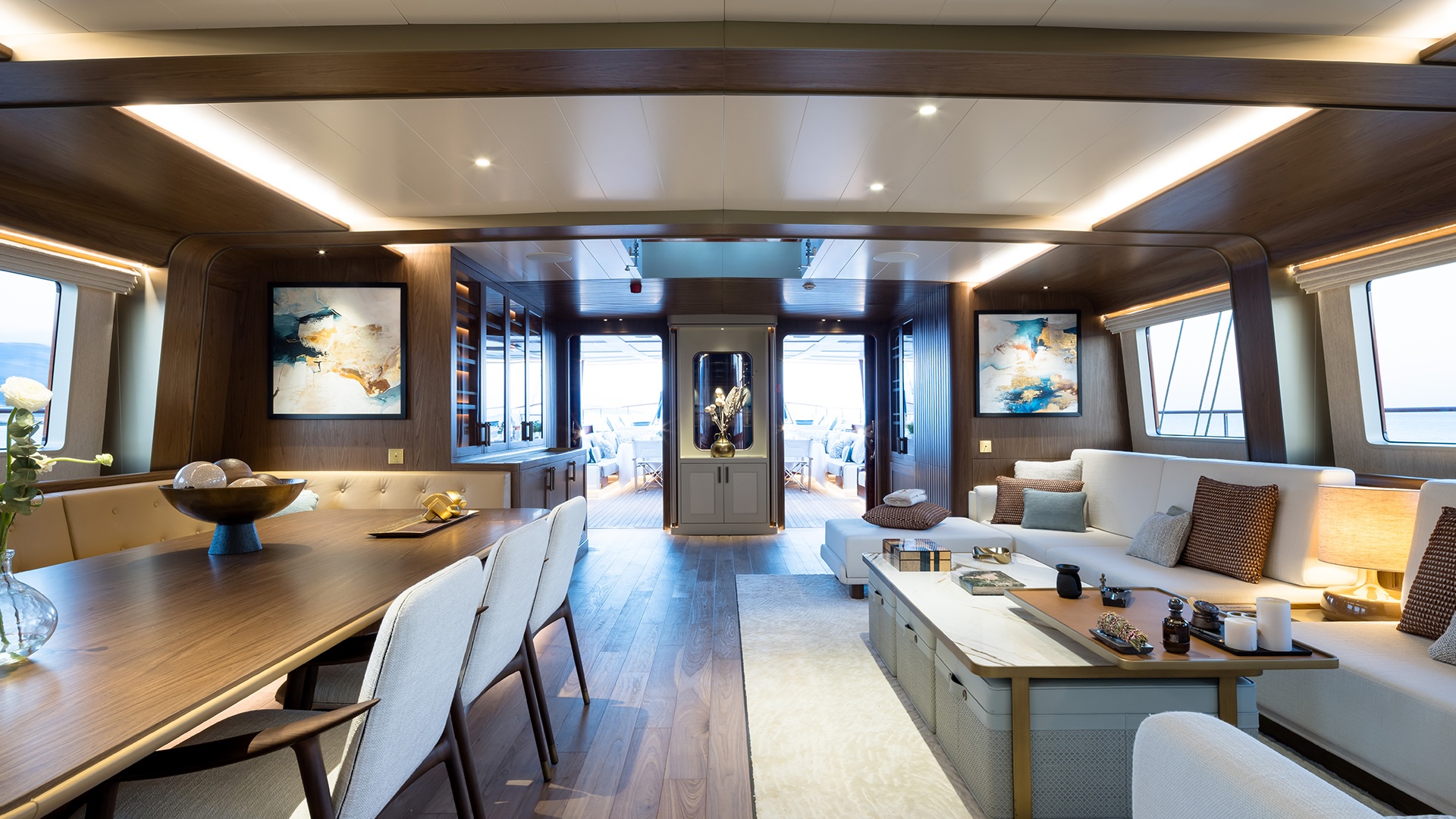
Twin doors open into the main salon, and the room reveals its register immediately. Darkened oak panelling on the walls, cream carpet underfoot, pale upholsteries. The brass that runs as a thread through the entire yacht — beams supporting the superstructure, legs of the coffee table, the mesh light fitting that hangs over the central staircase — appears here as a quiet structural cameo rather than a decorative flourish.
Design Unlimited, the Hampshire studio behind the interior, drew the room to balance the ketch's classic exterior promise against a contemporary domestic comfort. The custom furniture, much of it built with high-quality Turkish materials, underlines the yacht's backstory without performing it. The salon reads less like the interior of a sailing yacht and more like a private library that happens to be afloat.
A visual passage through the yacht
 01 · Aerial
Evening · Mediterranean
01 · Aerial
Evening · Mediterranean
 02 · Profile
Side view · Coast
02 · Profile
Side view · Coast
 03 · Underway
Hull at speed
04 · Full sail
Port profile
03 · Underway
Hull at speed
04 · Full sail
Port profile
 05 · Bow
Clipper bow · Detail
05 · Bow
Clipper bow · Detail
 06 · Flybridge
Exterior helm
06 · Flybridge
Exterior helm
 07 · Wheelhouse
Interior · Navigation
07 · Wheelhouse
Interior · Navigation
 08 · Owner's suite
Master · Forward
08 · Owner's suite
Master · Forward
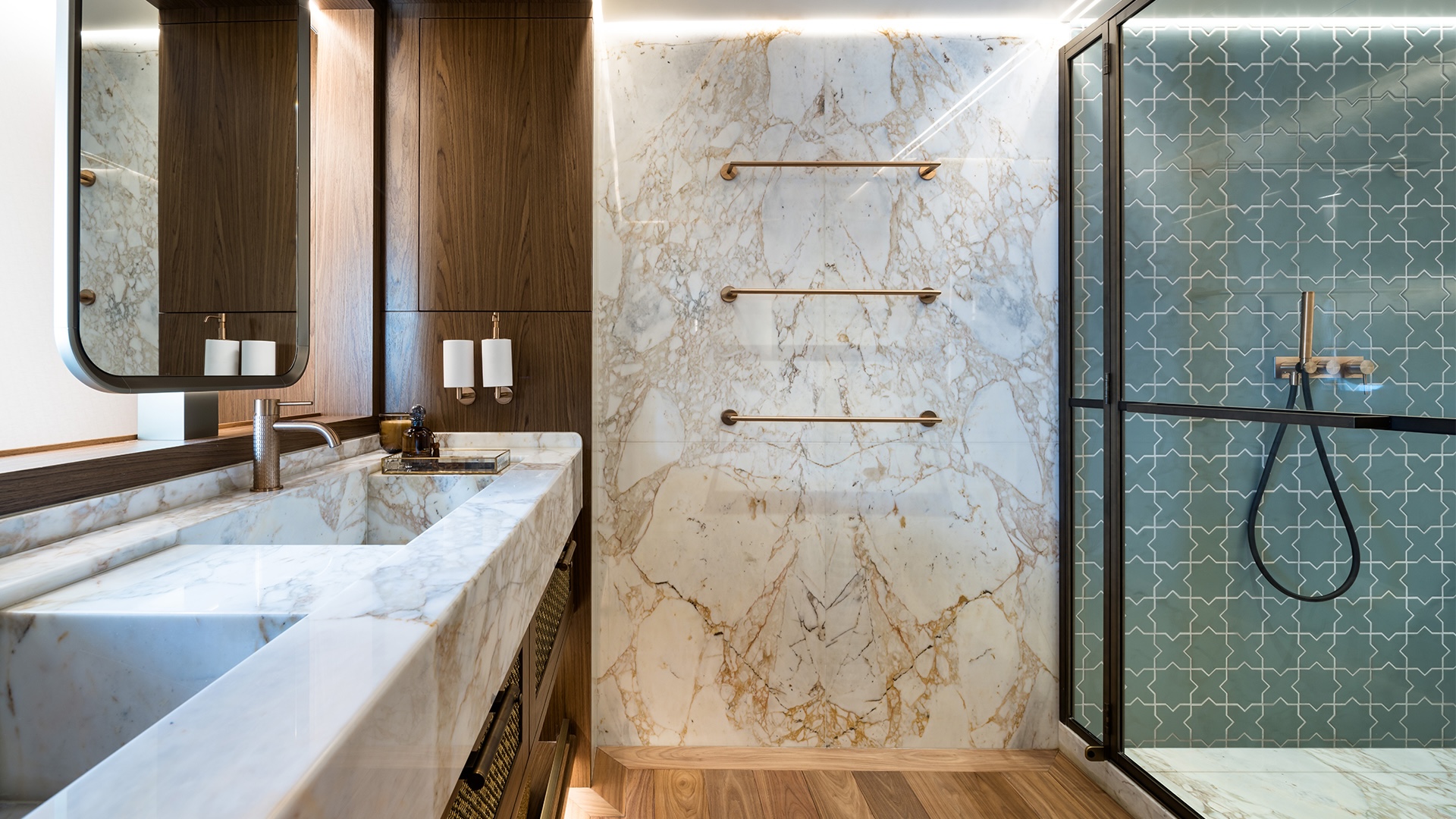 09 · Master bath
Stone · Brass · Gessi
09 · Master bath
Stone · Brass · Gessi
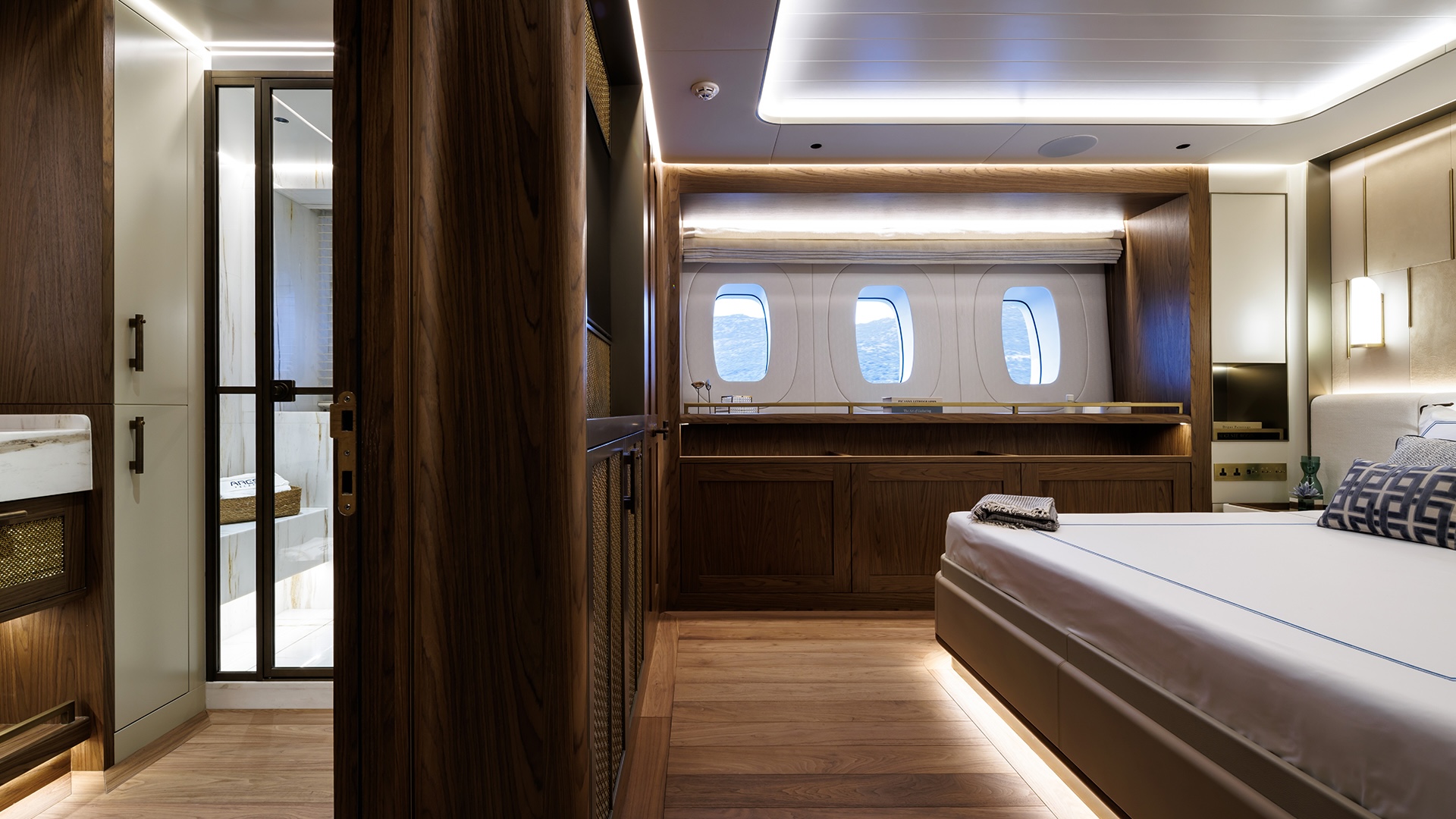 10 · Guest cabin
Woven leather · Mahogany
11 · Salon
Main-deck living
10 · Guest cabin
Woven leather · Mahogany
11 · Salon
Main-deck living
 12 · Dining
Formal · Interior
13 · Main deck
Aft cockpit
12 · Dining
Formal · Interior
13 · Main deck
Aft cockpit
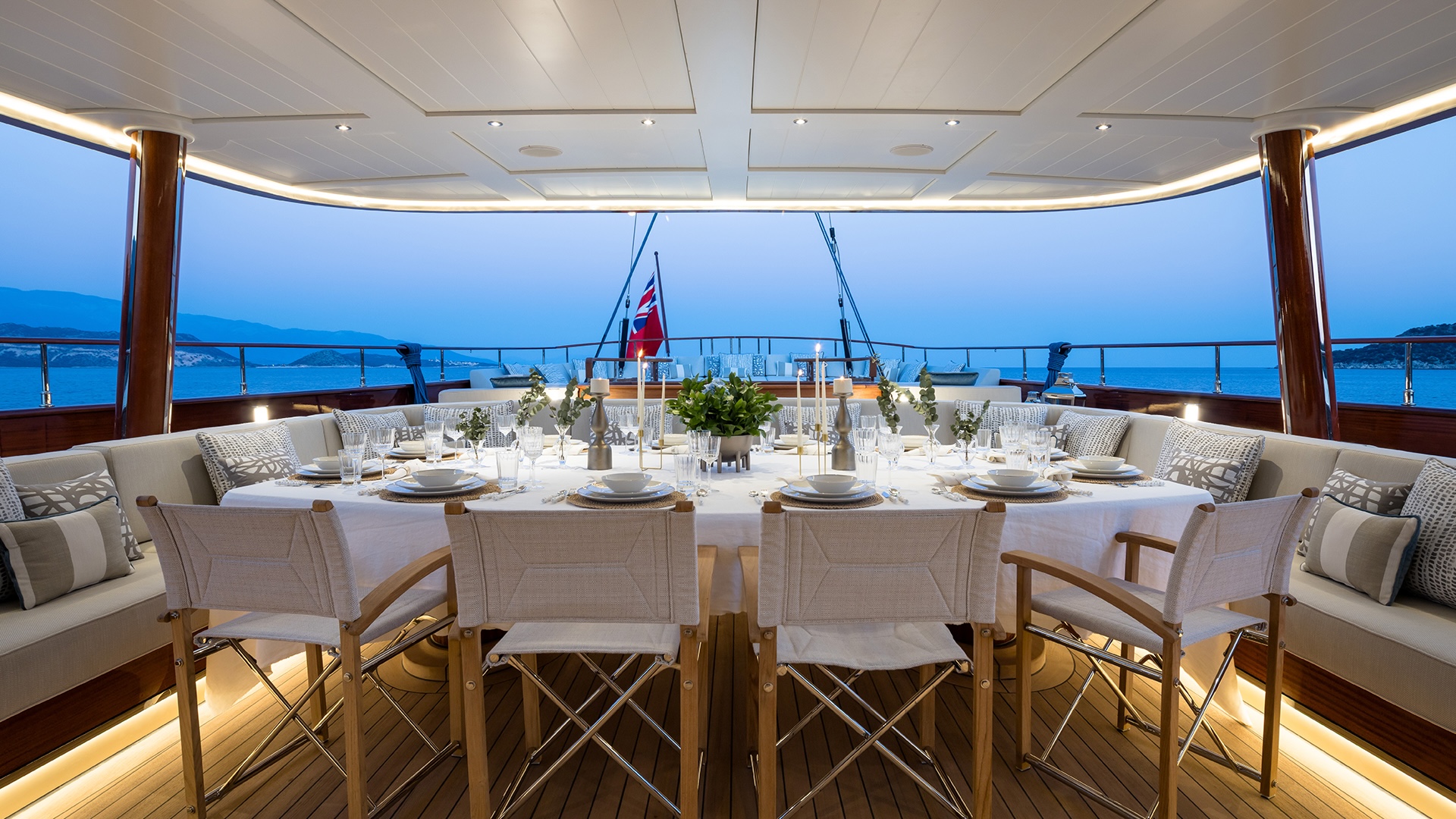 14 · Outdoor dining
14 guests · Mahogany
14 · Outdoor dining
14 guests · Mahogany
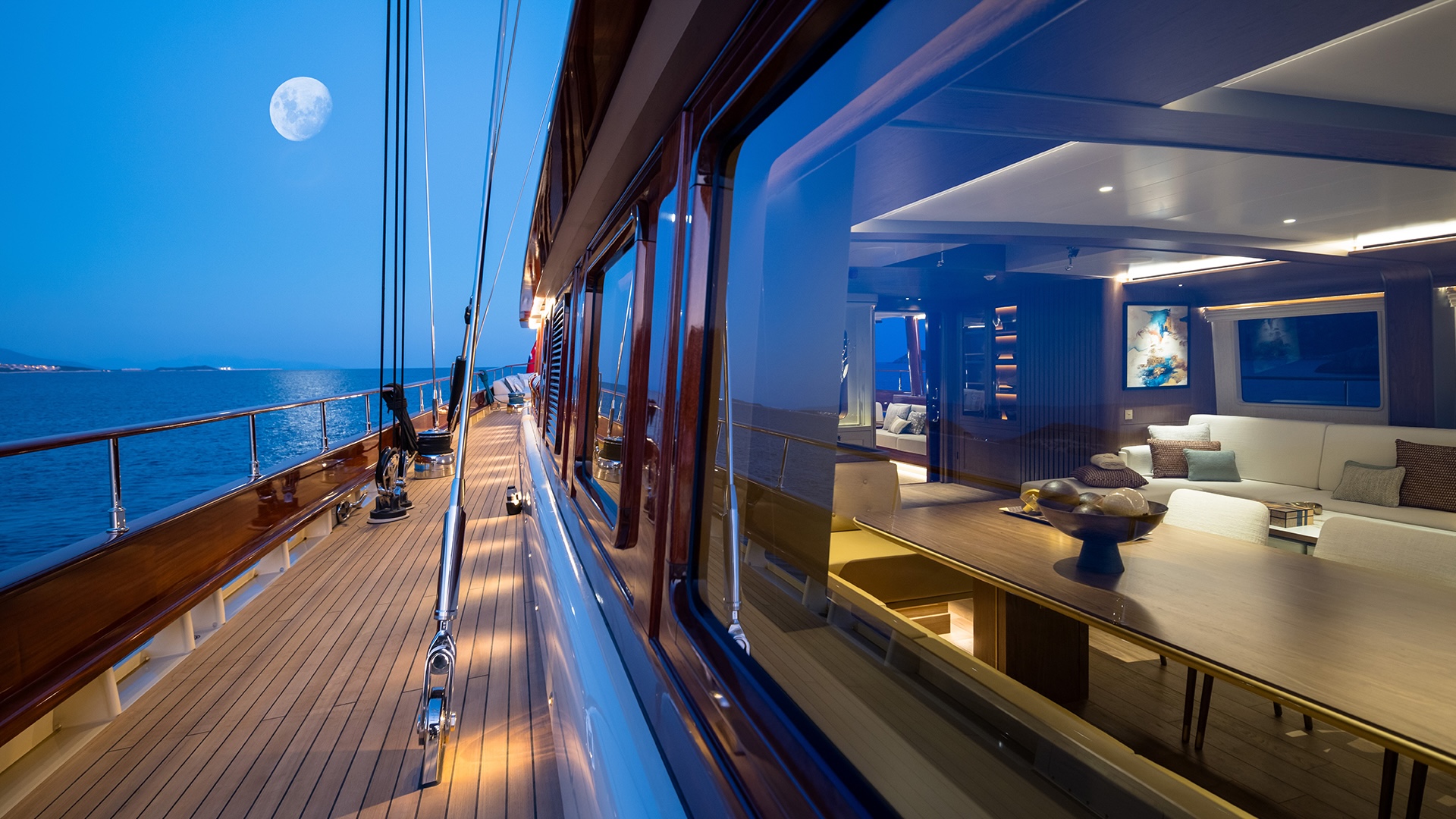 15 · Side deck
Moonlight · Passage
15 · Side deck
Moonlight · Passage
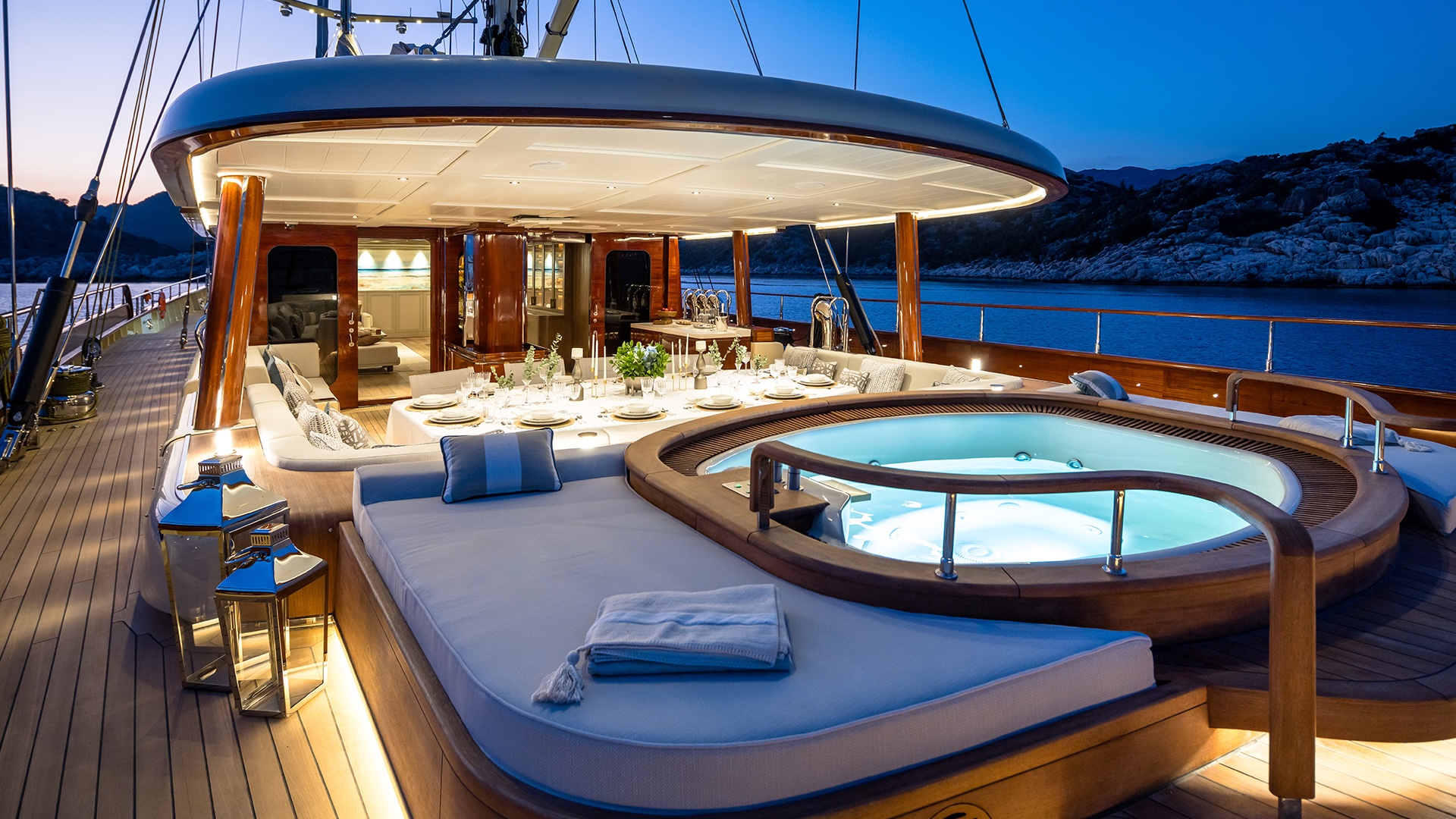 16 · Jacuzzi
Aft deck · Sunpads
16 · Jacuzzi
Aft deck · Sunpads
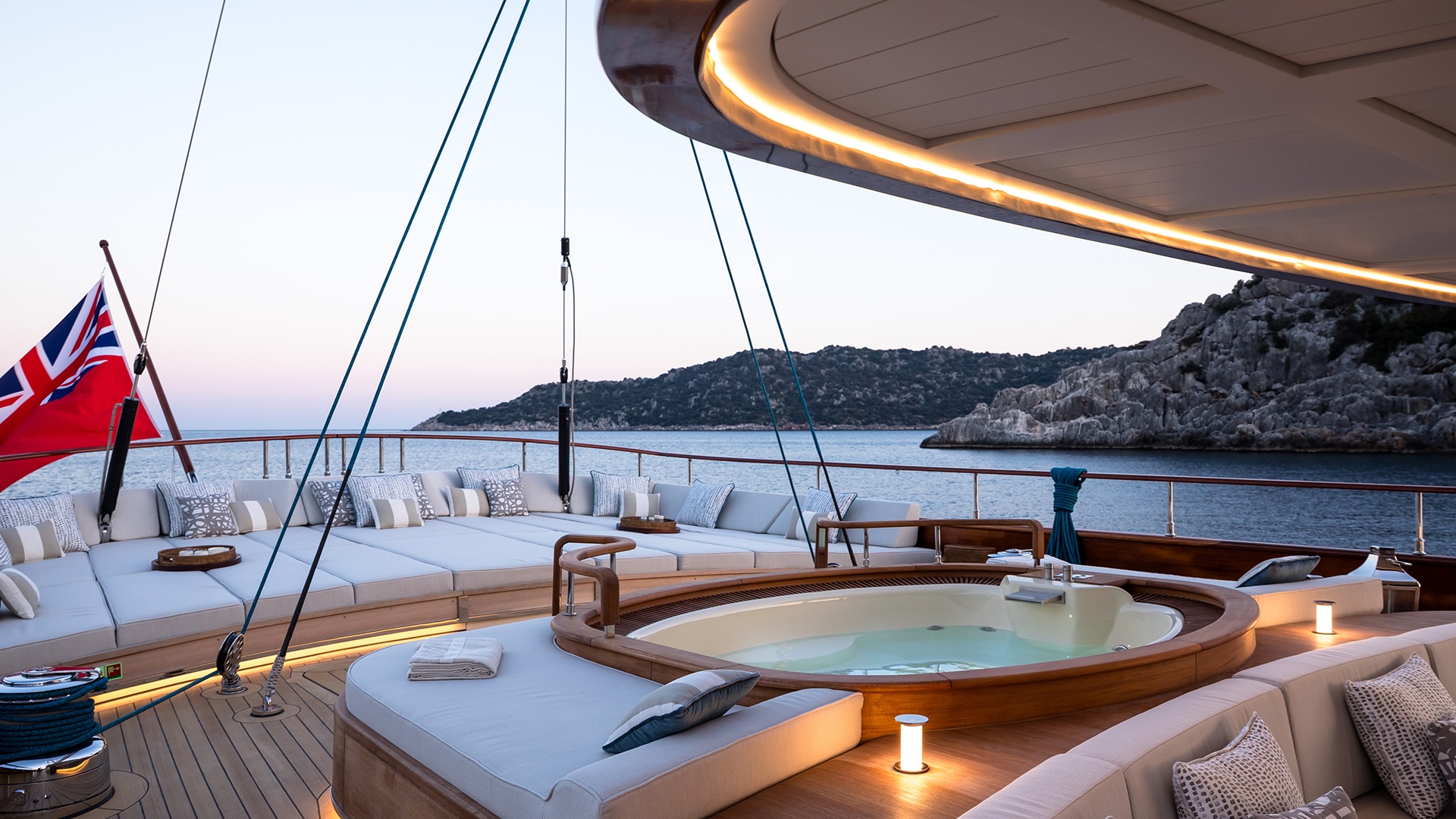 17 · Solarium
Stern · Horizon
17 · Solarium
Stern · Horizon
Turkish stone, sipo mahogany, antiqued brass
The material vocabulary deepens in the bathrooms. Beautiful Turkish stone — greys, lavenders, and a striking brass tone running through the marbling — pairs with the Gessi black-and-brass fittings to elevate spaces that are often overlooked in yachts of this scale. The stone is not imported European marble. It is local, by design, part of the yacht's quiet insistence that being built in Türkiye is a statement of materials, not just of geography.
Across the cabins, the recurring palette holds: woven leather on the walls, glass-encased brass mesh as a recurring screen, lustrous sipo mahogany panelling, walnut cabinetry. Subtle differences in headboards distinguish each guest cabin without breaking the language. The result is a yacht where the material consistency is more visible than the geographical accent — but the accent is there if you look for it.
A low-profile flybridge, sunken into the structure
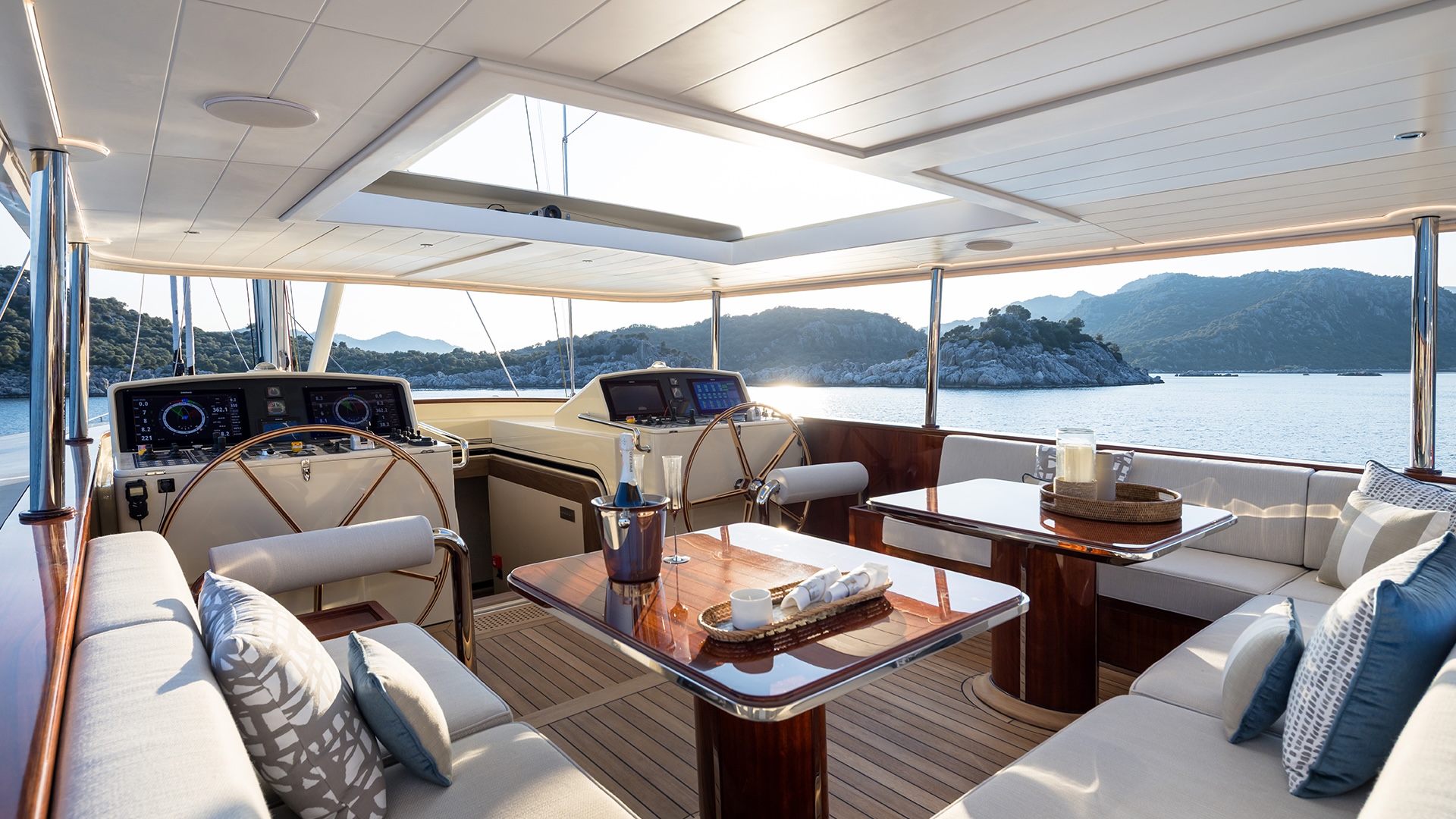
The flybridge on a 62-metre sailing yacht is, in most builds, the architectural compromise. The space is necessary; the aesthetic cost is significant; the silhouette suffers. Simena resolves the problem by burying the flybridge inside the superstructure rather than stacking it on top. A broad companionway leads up to a sunken deck behind a slim mahogany coaming. From the water, the flybridge is almost invisible — Taka's stated intent — and from the deck, it is one of the most pleasant places on the yacht.
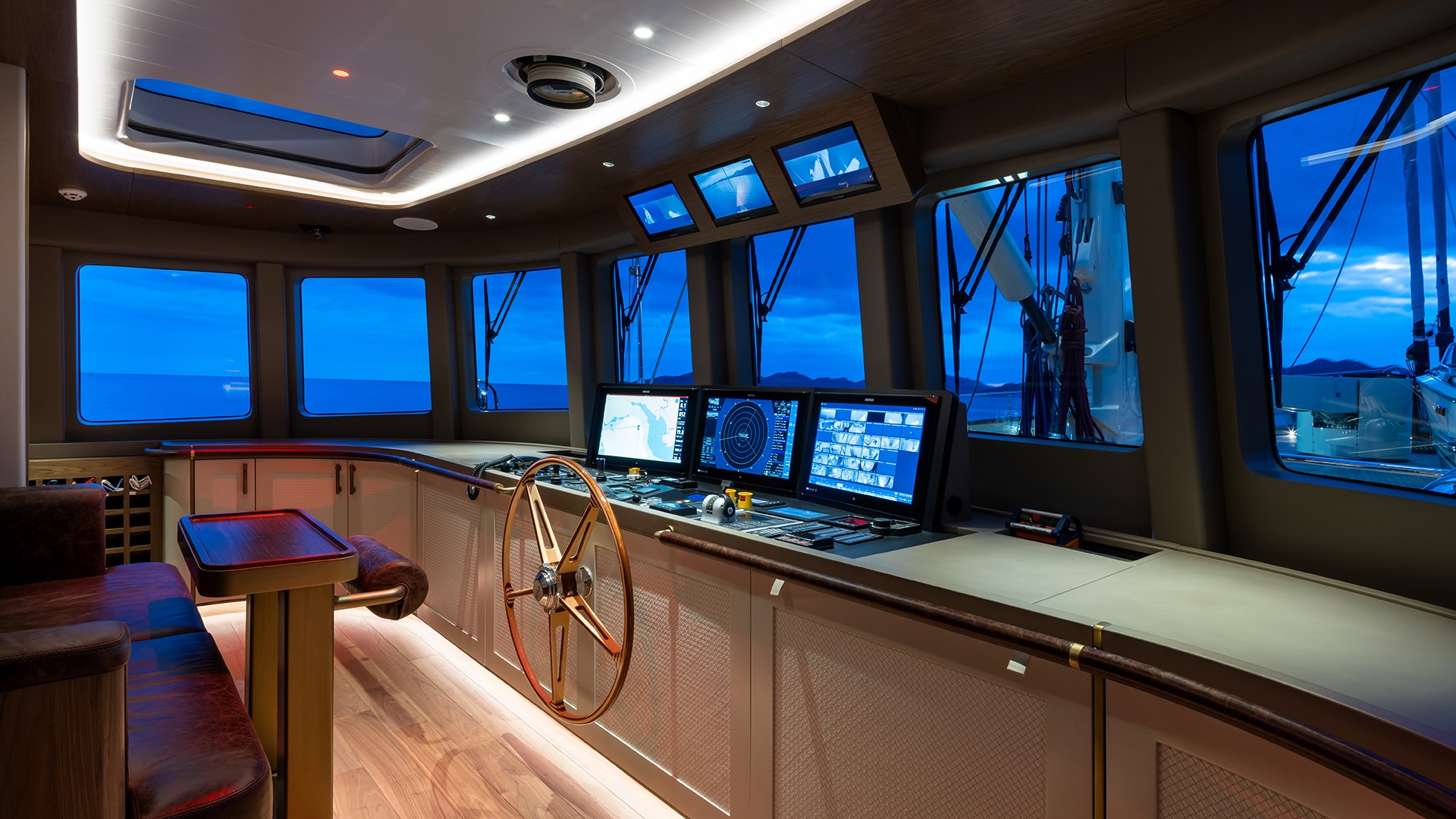
Custom seating rings two smaller tables. Sunpads stretch behind. A sliding glass companionway opens to twin helm stations — the captain's working position when the wheelhouse is not in use — and a sliding sunroof above keeps the rig visible from below. The 60-square-metre foredeck lounge, set forward of the wheelhouse, completes the upper-deck logic: a daytime room and an evening party space, depending on what the cruise is asking for.
A king-size bed, a brass mesh, a half-open bath
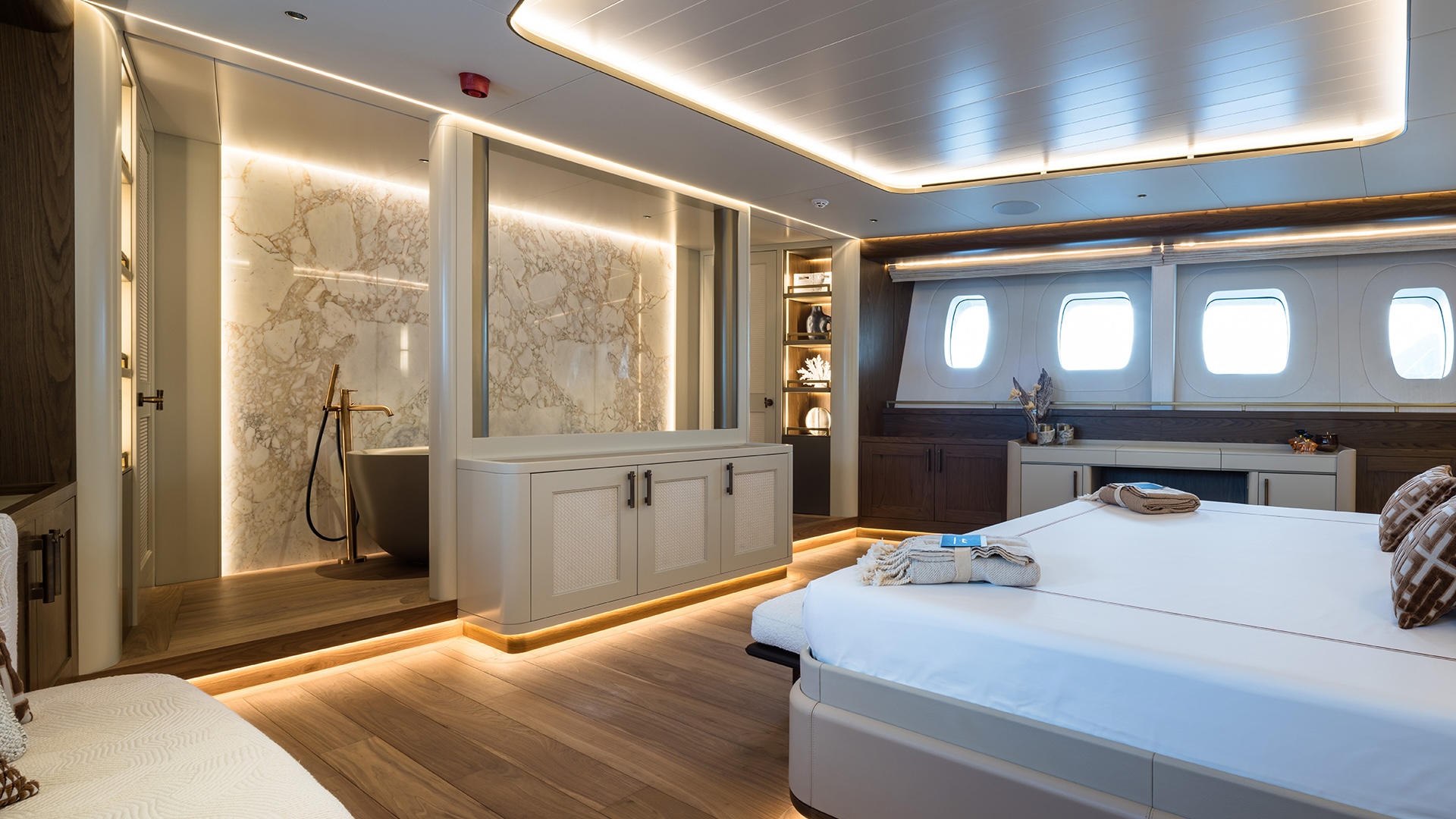
The owner's cabin fills the bow, reached down a private corridor that closes off from the rest of the guest accommodation. A king-sized bed sits in the centre of the room, screened from the door by an intricate panel of brass mesh encased in glass — an architectural cameo, not a partition. The bathroom is half-open to the cabin, so that a person soaking in the freestanding tub can speak comfortably to someone reading on the bed.
A walk-in wardrobe, a sofa lounge, a vanity that doubles as a desk with portholes that frame the horizon. Simena sleeps twelve across five cabins — two VIPs, two doubles, and a flexible twin — supported by a crew of nine. The dramatic central staircase, with its moulded brass-finished handrail recessed into textured wall panels, separates the guest and crew areas on the lower deck. Above it hangs a custom light fitting, crafted from metal mesh in curves that, by the designers' own description, replicate the oceanic currents of the Mediterranean.
A new benchmark for what can be achieved in Türkiye in large custom sailing.
Tanju Kalaycıoğlu · On the project's significanceThe numbers behind the silhouette
What Simena means for the segment
There are roughly twenty sailing yachts over 60 metres in the world. Most were built in northern Europe — Vitters, Royal Huisman, Perini Navi, Baltic, Oceanco — by yards with a half-century or more of pedigree in the discipline. Simena arrives from Antalya as the first serious entry from a new geography, and she does not arrive quietly. Brokers describe her as the largest sailing yacht of her type ever built. Her first public appearance, at the Palma International Boat Show, places her as the largest yacht on display at one of the European calendar's defining shows.
For ARES Yachts, Simena is the first vessel in a stated programme of high-profile superyacht builds over 50 metres. The yard's chairman, Kerim Kalafatoğlu, has framed her as the calling card for an expanded operation; the 51-metre Spitfire, in collaboration with Bannenberg & Rowell, is already under construction in the same Antalya sheds. Simena, in this reading, is not a one-off but a thesis — the proof that a Turkish yard can deliver a custom sailing superyacht at the highest tier of the global market, in steel, carbon and silence.
Whether the segment as a whole agrees will be settled, in the way these things are always settled, by the second boat. Until then, Simena sails her first Mediterranean season under the brokerage of Northrop & Johnson, available for ownership and — in due course — for charter, in a category that has not had a new arrival of this calibre, from this geography, before now.
Eternal moments, drawn in steel, carbon, and the long line of the ketch.
USA Onboard · EditorialA 62-metre ketch built in steel and carbon, drawn around a clipper bow and a sweeping sheerline, finished in sipo mahogany and Turkish stone — and rigged to cross oceans in near silence. Türkiye, drawn into the upper register of the global sailing-superyacht market.
USA Onboard · Editorial Feature · 2026