



MOST READ

NEWSLETTER

Luxury boating stories, delivered to your inbox every week.

EDITOR'S CHOICE

Begin Reading
Safety

The art of anchoring correctly

Whether the stop is for a few hours or for the night, a maneuver carried out with care and unhurried attention is what separates a peaceful anchorage from a long, restless watch.

Maneuvers Editorial Feature 9 min read

Anchoring is, by some distance, one of the most consequential maneuvers undertaken on board. The day's pleasure depends on it. So does the quality of the night that follows. A boat well secured in a place chosen with care will not move when it should not move — and the difference between a comfortable evening and an uncomfortable one is rarely the weather. It is, more often, the maneuver itself.

The anchoring system is built from three components: the bow windlass, the anchor itself — sized to the length and weight of the boat — and the chain that connects the two. Smaller boats often run a mixed system of chain and rope, the rope chosen for strength, flexibility and a high coefficient of stretch, so that the chain does not rub against the deck or topsides where it would otherwise mark them. The system is simple. The discipline lies in how it is used.

Before any of that, however, comes the question of where. A trip planned in advance includes, as a matter of course, a reading of the seabed at the intended anchorage. Coarse sand is, in most circumstances, the optimal bottom; mud and finer sand also work; rocky, stony, or seagrass bottoms offer poor grip and should be avoided where possible. Knowing this in advance is what determines, before anything else, whether the boat carries the right anchor for the day's destination.

3:1
Minimum scope
fair conditions
5:1
Recommended
everyday scope
7:1
Heavy weather
scope
3
Components
of the system
A boat at rest · Bow and stern, alongside an island
Components · What holds a boat in place

The anchor, the chain, the seabed

The relationship between anchor and seabed is not one of weight alone. An anchor holds because it is buried, not because it is heavy — the geometry of the device is what allows it to bite, dig, and resist a load applied along the chain. Different anchor designs bite differently in different bottoms, which is why most cruising boats carry the type best suited to the waters they spend most of their time in.

Among the patterns most commonly seen on yachts: the CQR or plough remains one of the most popular and effective designs, working well on sand, mud, stones and seagrass; it is not recommended for rocky bottoms, and when it does drag it tends to do so smoothly and uniformly. The Bruce, with its pronounced grip and self-righting geometry, performs particularly well where there is little room to release a long scope of chain, and excels in soft bottoms. The Danforth, lighter and widely carried on smaller boats, is the optimal choice in sand.

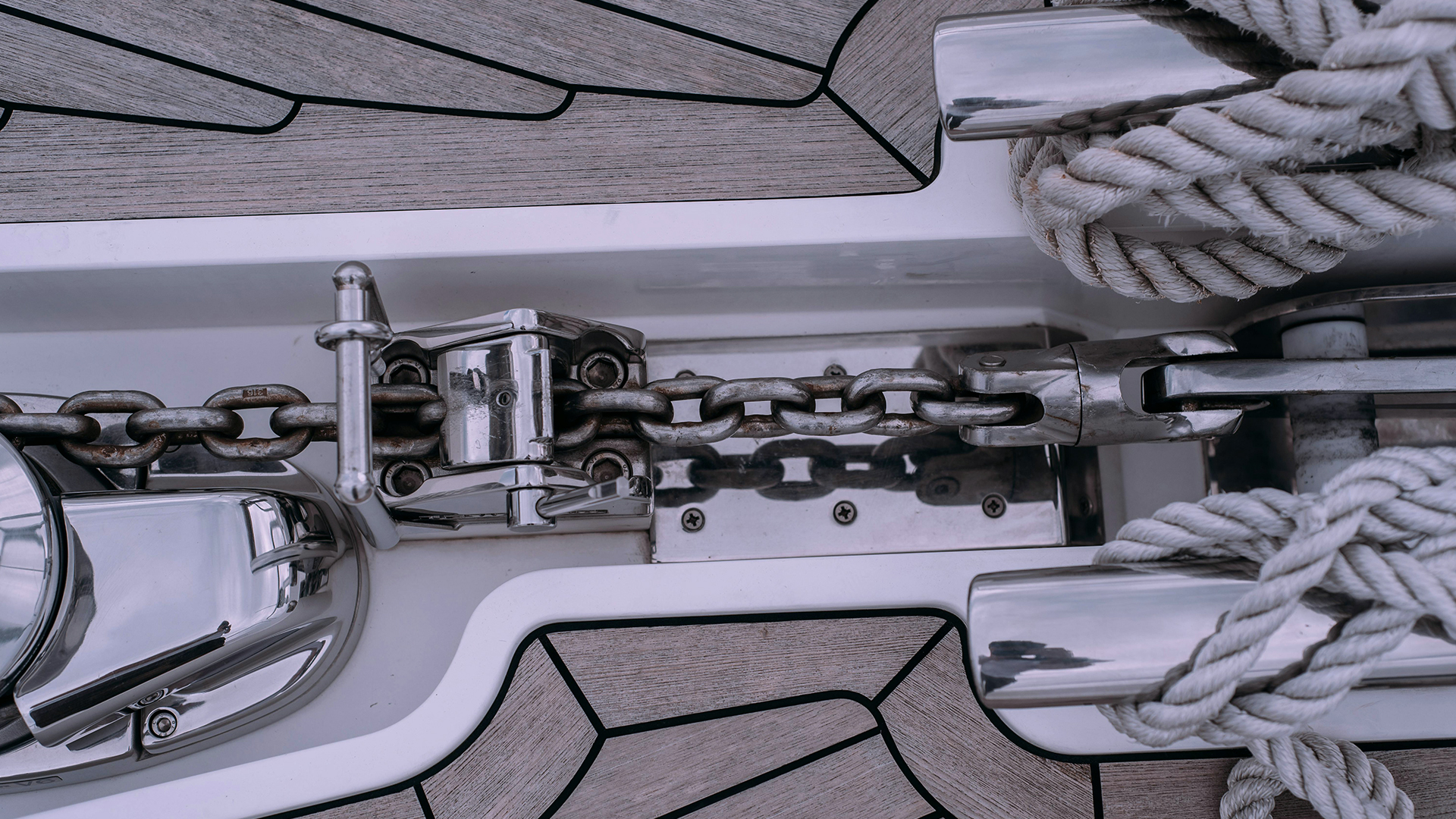
The chain is the second silent partner. Its thickness and link diameter should be matched to the boat's dimensions — a chain too light for the boat will not deliver the catenary that makes a good anchorage possible. A small but useful practice: paint a few links at fixed intervals, so that the amount of chain released is read visually as it runs, not estimated after the fact.

Chain running from the bow windlass
The chain · In motion

A maneuver that begins before the throttle

Long before the windlass turns, the maneuver is already in progress: chart consulted, depth read, seabed identified, neighboring boats observed, swing room calculated. The chain that runs out of the bow afterwards is only the visible part of an exercise that begins inland and ends with a glance at a fixed point on the coast.

A boat that drops the anchor without that preparation has, in practice, simply let the chain go and hoped. Most of the time, hope is enough. The remaining percentage, which is when seamanship matters, is what this maneuver is trained for.

The maneuver · Step by step

Eight movements in their right order

01
Choose the place before everything Select an anchorage protected from the prevailing wind and waves of the area, especially if the stay will be extended. Increasing wind and waves produce the jolts that detach an anchor from the bottom or break a component of the system. Check the depth and seabed indicated by the chart before approaching.
02
Reckon the swing circle The boat will swing around the anchoring point under the action of wind, current, or both. Leave a distance equivalent to the boat's length plus the chain released, relative to neighboring boats. The numerical example is straightforward: with thirty meters of chain in five meters of water and a ten‑meter boat, the possible swing radius is about thirty‑five meters. Confirm that area is clear before any further step.
03
Free the anchor and let it hang The anchor is secured during navigation to prevent dangerous release at speed. Before starting the maneuver, free it and let out a short length of chain so that the anchor hangs from the bow, ready to drop.
04
Bow into the wind, at very low speed Position the boat into the wind and move a few meters past the chosen spot at minimum speed, watching the depth on the instruments. Stop at the position. Then release the anchor, allowing for a chain length several meters greater than the depth.
05
Wait for the boat to settle Once the appropriate length of chain has run out, wait. The boat will first cross the wind and then drift backward, guided by the relationship between wind and current, until the chain stretches fully and the anchor digs into the bottom.
06
Release the rest, in line with the anchor Once positioned, release the remaining meters of chain so it stays under tension and aligned with the anchor. In good weather, between three and five times the depth is suggested. In stronger winds, up to seven times.
07
Verify the set Establish a fixed point on the coast and watch the boat's position relative to it. Read the anchoring line: a chain that is constantly tight and vibrating means the anchor has not bitten and the boat is moving backward; a chain that tightens and slackens in alternation means the anchor is properly set. If the navigation instruments include a dragging alarm, activate it now.
08
Lights, if night At night, switch on the anchoring lights as the maneuver finishes. The exercise is complete; the watch begins.
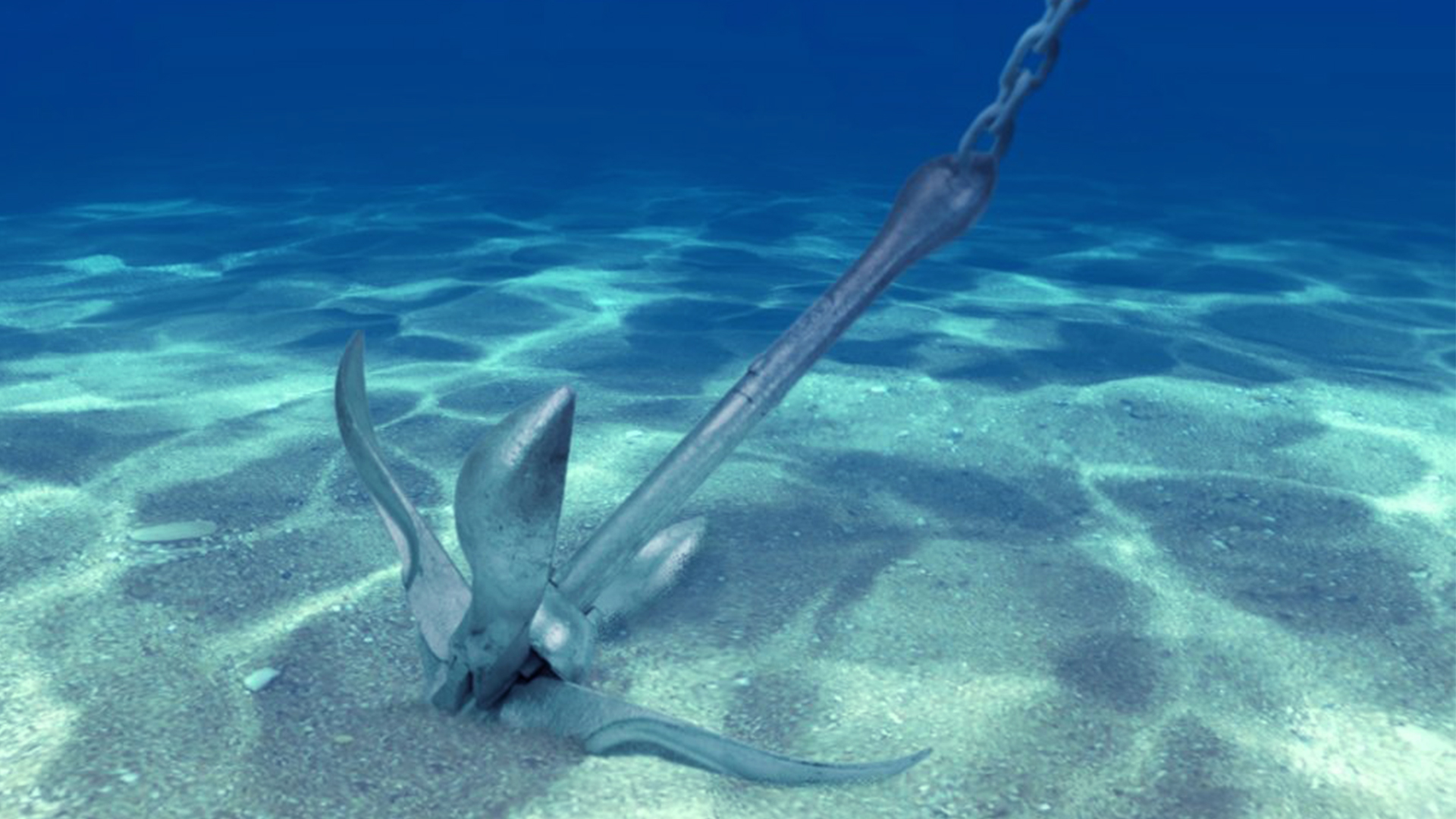
Anchor buried in white sand under transparent water
The set · What good holding looks like

Buried, not lying

An anchor seen lying on the seabed has not yet done its job. An anchor that has done its job is half‑buried, with the chain emerging at an angle from a small ridge of disturbed bottom. The geometry of the device, pulled horizontally by a tensioned chain, drags it sideways through the substrate until its surface resists movement.

In waters clear enough to permit it, a check with snorkel mask is the most direct way to confirm the set. In opaque water, the substitute is the fixed point on the coast and the rhythm of the chain — slack and tight, slack and tight, in time with the gusts.

The seabed · What lies below

Five surfaces, five behaviors

Best

Coarse sand

The optimal substrate. Most modern anchor designs bite quickly and hold reliably. Visual confirmation is easy when water is clear.

Reliable

Mud and fine sand

Reliable for most anchor patterns, particularly those designed for soft bottoms. The set takes longer; the hold, once achieved, is often excellent.

Caution

Stones and gravel

The anchor may catch on a stone rather than dig. The hold is unpredictable and a strong gust can release it suddenly. Avoid where possible.

Avoid

Seagrass & rock

Seagrass prevents the anchor from reaching the substrate beneath; rocky bottoms offer no penetration at all. Both should be avoided when alternatives exist.
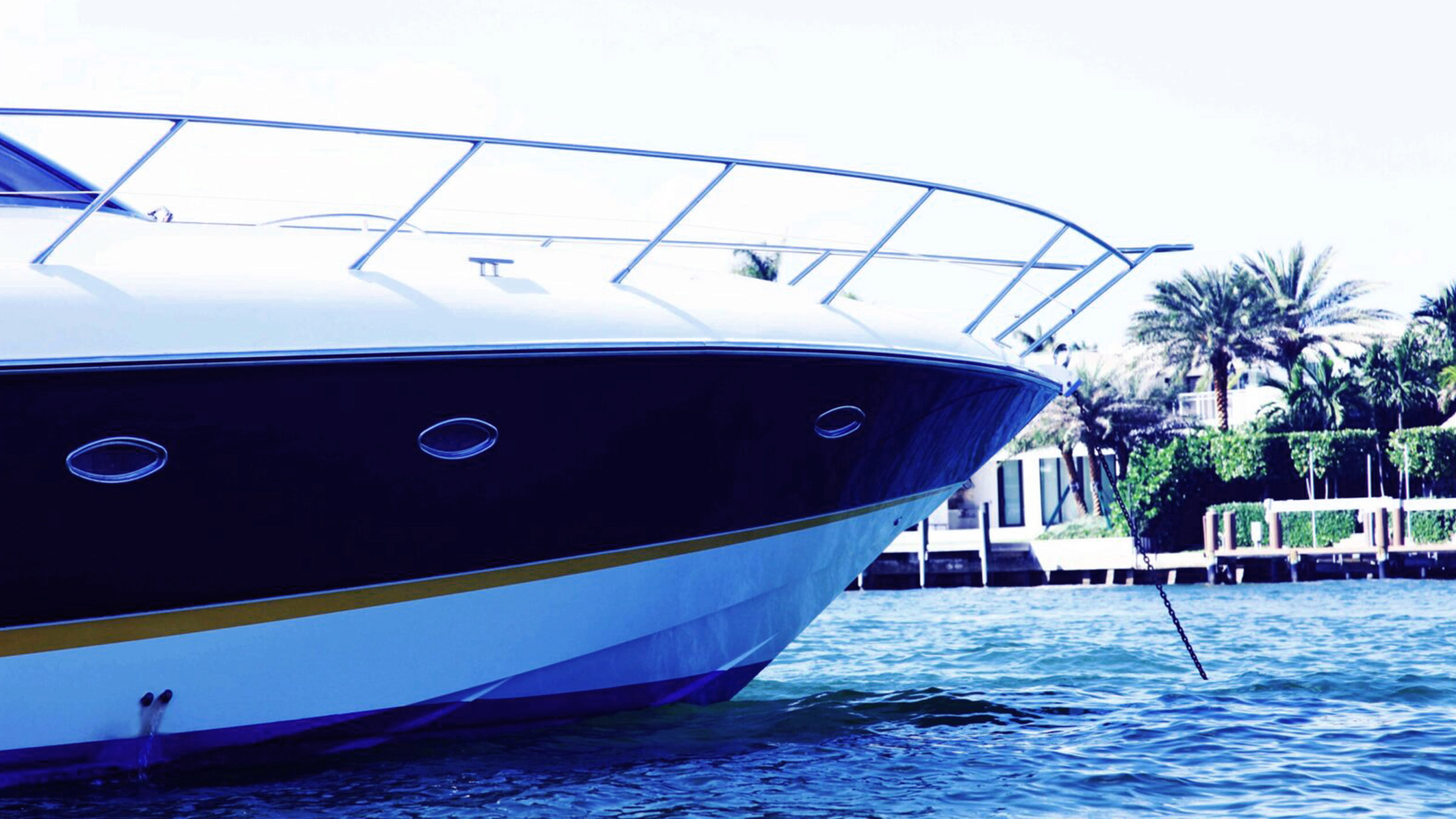
Profile view of a yacht's bow and anchor chain in a channel
Through the night · The boat at rest

A boat at anchor is never quite still

Even in the calmest harbor, an anchored boat is in continuous, almost imperceptible motion. The chain breathes; the wind shifts a few degrees; the current changes direction with the tide. What looks like rest is, in fact, a system in equilibrium. The captain who understands that does not expect stillness — he expects regularity.

Irregularity is the alarm. A new sound at the bow, a slack line that should be tight, a shift of the boat's relationship to the fixed point on the coast — these are what the anchor watch is, in practice, watching for.

Worth keeping in mind

Three reminders for the watch

Wind · Current

If the direction changes, watch the fleet

If the wind or the current shifts, observe whether the surrounding boats all swing in the same direction. They should. When one boat is out of phase with the others, the awkward situations — and occasionally the collisions — begin there.

Crowded anchorage

Less chain, but not less hold

In a busy anchorage, releasing less chain reduces the swing radius and protects against neighbor contact. Less chain is acceptable; less grip is not. The shorter scope is only valid if the seabed is reliable and the conditions remain settled.

Overnight

Pick a quieter corner

For an overnight stop, anchor in a more secluded area, away from neighbors. Where the water is clear, a quick check with diving glasses confirms the set. If the instruments offer one, the dragging alarm should be on for the night.

In the morning · Departure

Raising the anchor, without hurry

Lifting the anchor is the simpler half of the exercise. The engine is started, then placed in forward gear at very slow speed while the windlass collects the chain. When the chain stands vertical above the anchor, the boat is over the set; what remains is to bring up the last length and free the bow completely. Avoid abrupt movements at the final stretch — the anchor, on its way up, should not strike the hull.

A small detail of seamanship belongs here. Both this maneuver and the taking and leaving of moorings should be carried out as discreetly as the boat permits — not for show, but because shouted instructions and sudden movements between bow and helm are usually a sign that the maneuver was not planned beforehand. The reverse, when it is true, is also true: a quiet maneuver is almost always a planned one.
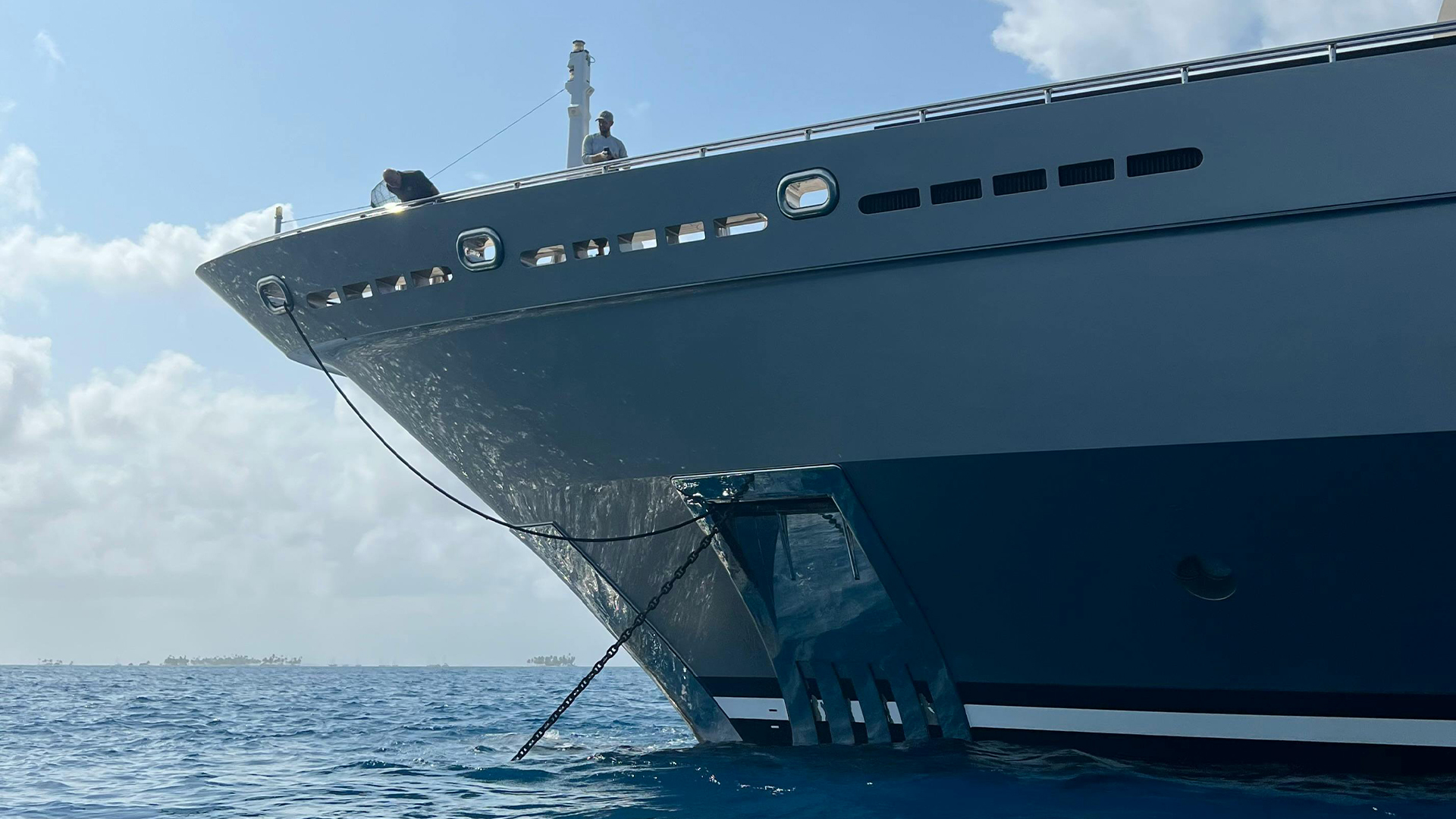
The bow of an anchored superyacht in calm water
A boat at rest · What a good anchorage looks like
A rule of seamanship

Do not shout. Do not run. Do not argue.

If the maneuver has been planned beforehand, none of it will be necessary.

USA Onboard · Maneuvers · Safety
This site is registered on wpml.org as a development site. Switch to a production site key to remove this banner.