

Twenty Months Later
Twenty months after the loss of the superyacht Bayesian off the Sicilian coast, the case has produced an interim technical report, a refloated hull, three crew members under criminal investigation, a half-billion-dollar civil claim, and two parallel theories of why she sank — one technical, one operational, both unresolved.
In the early hours of 19 August 2024, the 56‑meter sailing yacht Bayesian sank in just over sixteen minutes while at anchor in Porticello Bay, off the northern coast of Sicily. Of the twenty‑two people on board — ten crew, twelve guests — fifteen survived. Among the seven who did not were the British technology entrepreneur Mike Lynch, who owned the yacht, and his eighteen‑year‑old daughter, Hannah.
The Bayesian had set out from Rotterdam earlier in the season, transiting Belgium, France, the United Kingdom, Portugal and Spain before crossing the Strait of Gibraltar. After a stop at Milazzo and a day off Cefalù, she arrived in Porticello on the afternoon of 18 August and anchored roughly five hundred meters from shore. The cruise was, in part, a celebration: Lynch had been acquitted in San Francisco on 6 June 2024 of fifteen federal charges related to the 2011 sale of his company Autonomy to Hewlett‑Packard, and had brought aboard family, close friends and members of his legal team.
The night of the sinking has since become, in nautical terms, one of the most heavily examined incidents of the decade. The case has produced an interim report from the United Kingdom's Marine Accident Investigation Branch, a salvage operation that lifted the hull from fifty meters of water, a parallel Italian criminal investigation, a USD 540 million civil claim by the shipyard against the owner's widow and crew, and a public disagreement between investigators about what actually caused the boat to capsize. The final MAIB report has not yet been published. What follows is what is established, what is contested, and what remains, twenty months on, an open file.
overall
step to truck
on board
lost
A boat built to be remarkable
The yacht that sank as the Bayesian had not always carried that name. Originally christened Salute, she was launched on 15 April 2008 at the Perini Navi yard in Viareggio, Italy, the first owner unable, in the end, to take delivery. The boat passed through one further owner before being acquired in November 2014 by Revtom Ltd., a vehicle of Angela Bacares, Mike Lynch's wife, and renamed for the statistical theorem at the heart of the machine‑learning work that had built her owner's fortune.
The exterior was the work of Irish naval architect Ron Holland; the interiors, the work of French designer Rémi Tessier, in a quiet, Bauhaus‑adjacent register of pale woods, ebony, fir and leather, with restrained Japanese references. She measured fifty‑six meters overall, with a beam of 11.51 meters and a displacement, fully loaded, of 473 tonnes. Two MTU diesels of 965 horsepower each gave her a cruising speed of twelve knots, a top of fifteen, and a range of approximately 6,700 kilometers on her 57,000‑litre tanks. She was certified for twelve guests in six cabins and ten crew. In 2009 she received the Superyacht Award for the best sail yacht of the year.
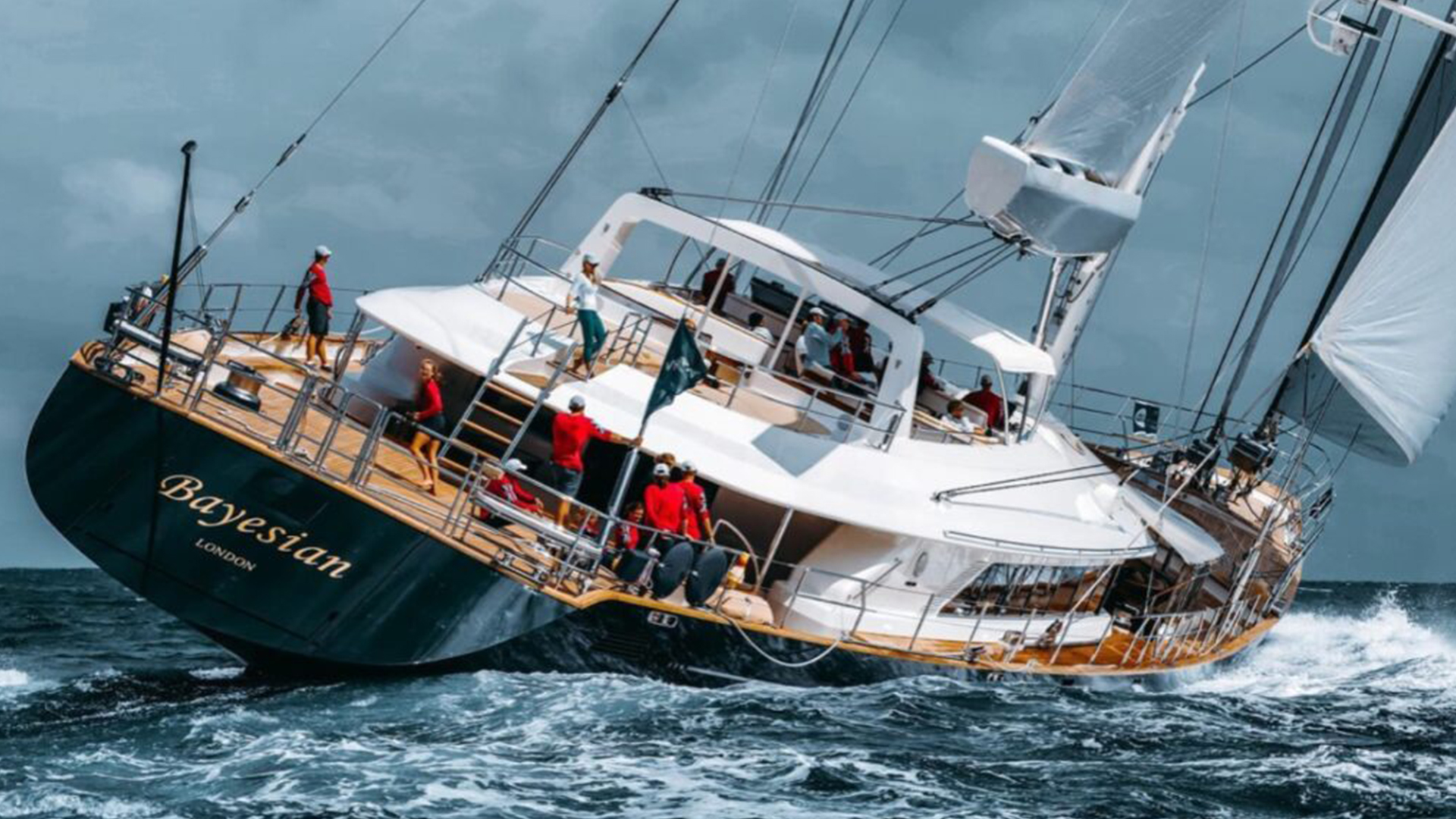
The detail that marked her apart was visible from the moment she came into view. Of the ten boats Perini Navi built in its 56‑meter series, the Bayesian was the only sloop — a single‑mast configuration produced at the request of her first client, where every sister ship was a ketch. Her single aluminum spar measured seventy‑five meters from step to truck — seventy‑two meters above the waterline by the measure later used by accident investigators — and was, as built, the tallest aluminum mast in the world. It was developed by Perini Navi's mast division in collaboration with Germanischer Lloyd and the University of Genoa, and it permitted the deployment of three thousand square meters of sail.
A configuration that concentrated everything in one spar
Nine sister ships in her series carried two masts. The Bayesian carried one — taller than any aluminum mast yet built. The decision was a client preference, not a structural preference, and for sixteen years it produced no incident of note.
In retrospect, the configuration would become the center of the technical conversation about why she sank. The unusual height of the spar concentrated a disproportionate share of the boat's wind‑exposed surface area in a single, very tall structural element — and that proportion, as later analysis would establish, mattered considerably more than her builders had documented in the ship's stability book.
Sixteen minutes that decided everything
The Bayesian had spent the afternoon and evening of 18 August at anchor in Porticello, roughly five hundred meters from the coast. Most of the twenty‑two people on board were below decks. A weather front was visible on the forecast and on the regional models. The Italian meteorologist Luca Mercalli, president of the Italian Meteorological Society, would later say that the conditions were predictable; what reached the bay shortly before four in the morning, however, exceeded the magnitude any of the boats anchored there had reasonably prepared for.
The chronology that follows is reconstructed from the MAIB interim report and from the eyewitness accounts of two men who were on the water that night.
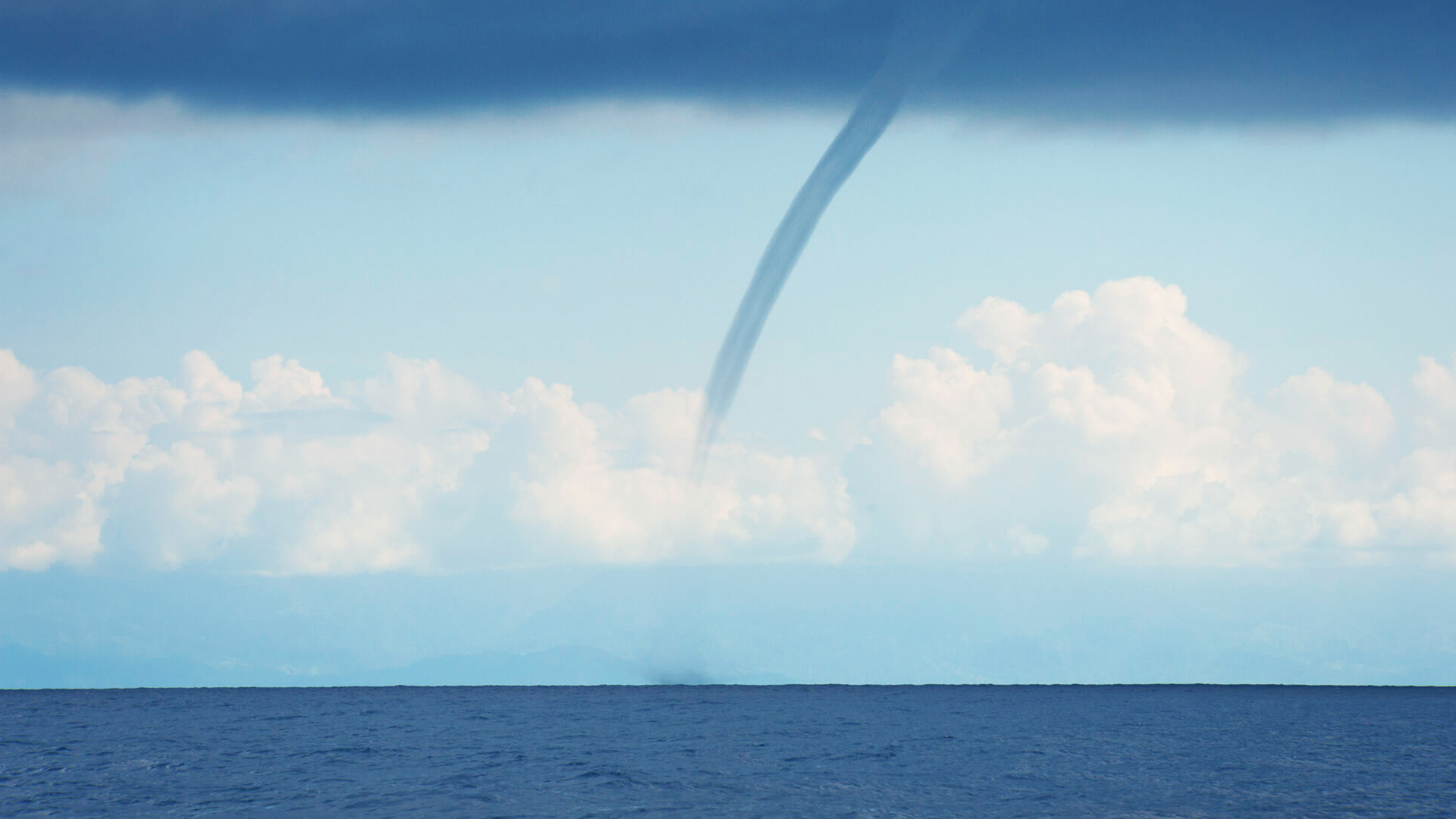
A waterspout, or a downburst
Witnesses on shore — Cefalù among them — described what they saw as a waterspout: a tornado at sea, formed by rotating columns of wind and water. The image is dramatic and largely accurate to the visual record. Subsequent investigation, however, has shifted the technical reading toward a downburst, a column of fast‑descending air from the storm cell that fans outward when it meets the surface.
The distinction matters less for the lay reader than for the technical case. Either phenomenon is consistent with sustained winds above seventy knots, with the Bayesian's measured wind of approximately eighty knots at the moment of the incident, and with the violence of the heel observed. The MAIB has described conditions of that magnitude as exceeding any operational threshold the yacht's stability documentation contemplated.
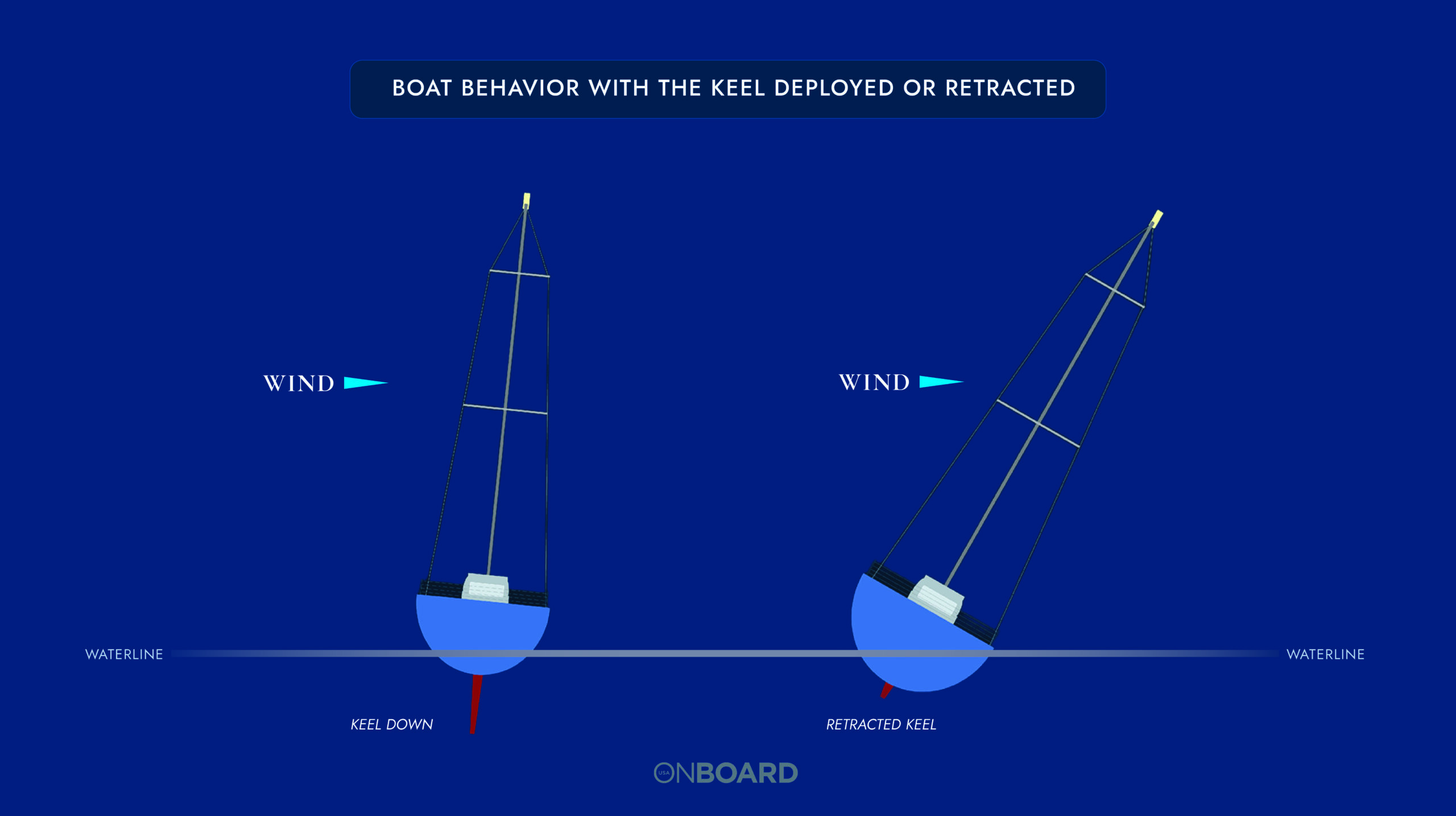
A second technical thread runs through every reading of the night: the position of the Bayesian's retractable keel. The keel measured roughly 9.7 meters at full extension and approximately 4 meters when retracted. At the moment of the incident, according to investigators, it was retracted — well short of mid‑extension. Whether it had been raised earlier in the day to clear shallow water and not redeployed, or had been left raised for other reasons, is one of the operational questions the criminal investigation in Italy is examining.
A former captain of the Bayesian, Stephen Edwards, observed in a technical analysis published on the nautical site Scuttlebutt that the boat carried only one access door in the hull, designed to be opened in flat‑calm conditions. Whether that door, or any other deck opening, was sealed in the minutes before the wind reached the bay is among the operational questions the criminal investigation in Italy is examining. The relationship between the keel position, the openings on deck, and the angle of vanishing stability is the central technical knot the final report will need to untie.
Lifting the hull from fifty meters
Italian law required the owner to bear the cost and the responsibility of refloating the wreck. The operation was contracted to TMC Maritime. The Rotterdam‑based heavy‑lift crane HEBO Lift 10 arrived in Sicilian waters on 4 May 2025 and preparations began immediately on the seabed.
On 9 May 2025, a Dutch diver of thirty‑nine years died in an underwater explosion during the preparation work; operations were suspended for almost a week, and human divers were subsequently replaced by remotely operated vehicles. On 15 May the MAIB published its interim report. Between 18 and 20 May, the boom and the anchor were recovered. On 17 June the mast was cut remotely to permit the lift. On 20 June 2025 — a day ahead of schedule — the hull broke the surface of the sea. Two days later, on 22 June, the Bayesian was transported to the Sicilian port of Termini Imerese, set down on a custom steel cradle, and placed at the disposal of investigators.
The operation cost an estimated thirty to forty million dollars. There was no fuel spill at any point during the salvage; the eighteen thousand litres of diesel aboard were recovered in full.
"I had never seen a boat of this size sink so quickly."
A technical version, and an operational one
Twenty months after the sinking, two distinct readings of what happened that night are on the record. They are not flatly contradictory; they emphasise different points along the same chain of cause. The MAIB's interim report, published in May 2025, frames the loss as the result of a structural and documentary vulnerability the crew could not reasonably have known about. A leak, in early May 2026, of the conclusions reportedly being formed by Italian prosecutors in Termini Imerese frames the loss as the result of a series of operational decisions made on board.
The MAIB's final report has not yet been published; expectations are for late 2026. Until then, both readings remain provisional, and the gap between them is one of the open files in the case.
The MAIB · A vulnerability not on paper
The interim findings center on a combination the on‑board stability documentation did not address: the disproportionate share of heel moment generated by the seventy‑two‑meter mast in bare condition (approximately fifty percent), the configuration that night (engines running, sails down, keel retracted, ten percent of consumables), and an angle of vanishing stability of 70.6 degrees.
Wind speeds above 63.4 knots, perpendicular to the hull, were sufficient to capsize her in that condition. The crew, in this reading, could not reasonably have anticipated the limit because it was not documented in the stability information book carried on board.
The Italian prosecutors · Operational decisions
According to a report by Sky News in early May 2026 citing a source close to the investigation, prosecutors at Termini Imerese are reported to be forming a different view: that the weather that night was "little more than a squall", that the loss was the result of misreading the conditions and of failures in activating safety procedures, and that the decisive factors were operational rather than structural.
Three crew members — captain James Cutfield (51, New Zealander), Tim Parker Eaton, and Matthew Griffiths (22) — are under investigation for involuntary manslaughter and culpable shipwreck. No formal charges have been filed; under Italian procedure, being under investigation does not imply guilt or guarantee charges.
Seven names that the case is, in the end, about
- Mike Lynch British technology entrepreneur, owner of the yacht
- Hannah Lynch Eighteen years old, his daughter
- Jonathan Bloomer Chairman of Morgan Stanley International
- Judy Bloomer His wife
- Christopher Morvillo Lynch's lawyer, partner at Clifford Chance
- Neda Morvillo His wife
- Recaldo Thomas The yacht's chef
The fronts that remain open
Captain James Cutfield, who is barred from leaving Italy while the investigation continues, and crew members Tim Parker Eaton and Matthew Griffiths are under investigation for involuntary manslaughter and culpable shipwreck. No formal charges have been filed; the investigation remains open.
The Italian Sea Group, parent of Perini Navi, filed a USD 540 million civil claim against Angela Bacares (Lynch's widow, owner of the boat through Revtom Ltd.) and three crew members, alleging the loss caused reputational and commercial damage. The shipyard maintains the Bayesian was "unsinkable if operated correctly".
The UK High Court ruled against Lynch's estate in the Hewlett‑Packard fraud case in July 2025, ordering payment in excess of £700 million; the figure was updated in March 2026, with interest and conversions, to approximately USD 1.24 billion. The estate now bears that liability alongside the salvage costs.
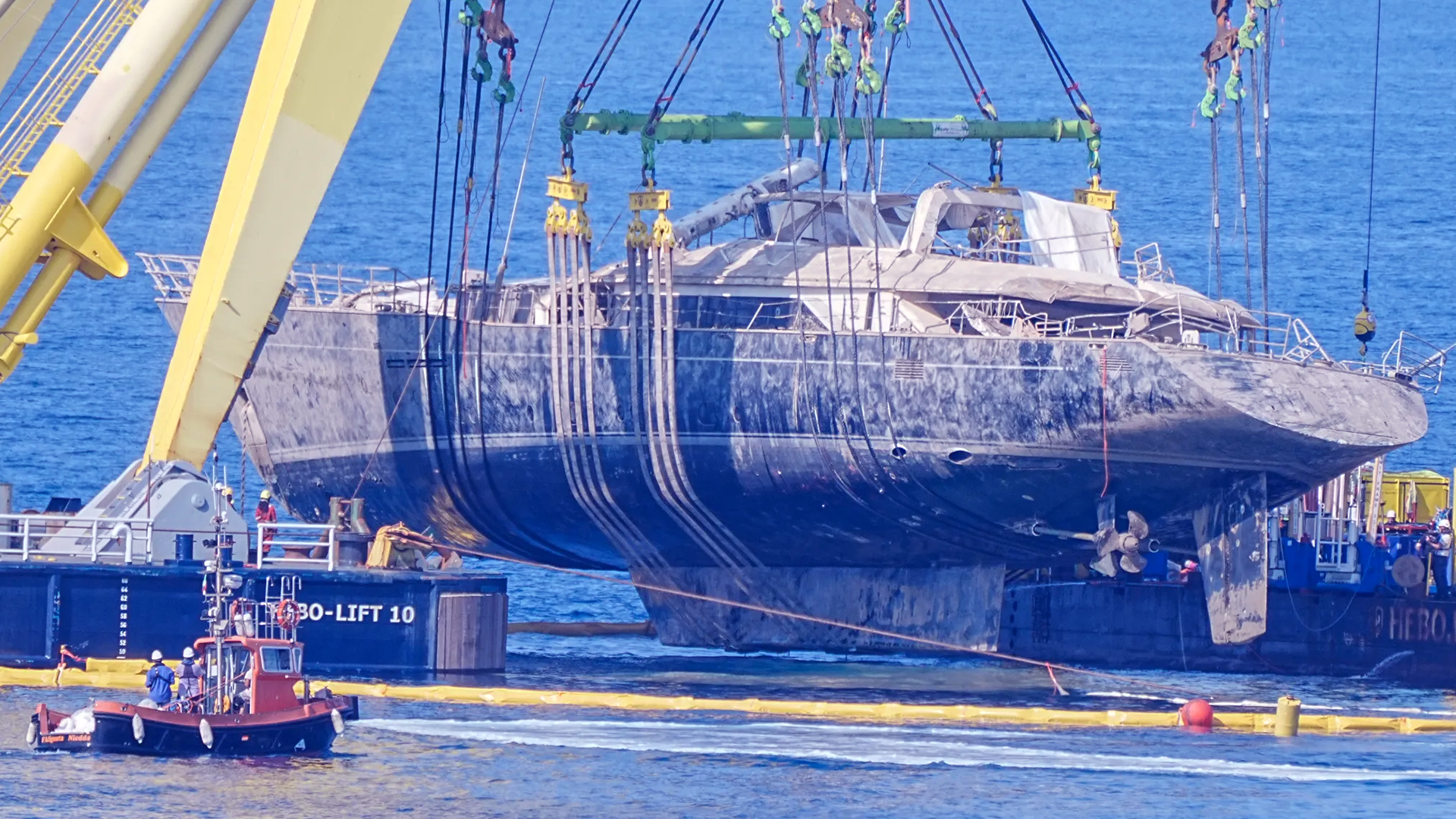
The hull is recovered. The investigations continue. The final report has not yet been written — and the case, twenty months on, remains open.