


A Deck of
One's Own
A 49.90-meter aluminum flagship that gives the owner an entire deck, drops a beach club with an infinity pool onto the waterline, and stays under five hundred gross tons. The most consequential entry Custom Line has made into the displacement segment in a decade.
Some flagships announce themselves with scale. The Custom Line 50 announces itself with a question: what would change if you handed an entire deck back to the owner, and built the rest of the yacht around that decision.
The answer arrived in Ancona in June 2024, when the Ferretti Group Superyacht Yard launched Asante, the first unit in a new aluminum series and the Custom Line debut in the displacement segment under 500 gross tons. Three months later the yacht made her world appearance at the Monaco Yacht Show. The proportions are familiar at a glance, 49.90 meters of length and 9.60 meters of beam across four decks, but the architecture inside those numbers is not. The upper deck is given over almost entirely to the owner's apartment. The stern is rewritten as a multilevel beach club with an infinity pool. The whole hull is aluminum, a material Custom Line had not used at this scale before.
The collaboration behind the project reads as a quiet exercise in continuity. The Strategic Product Department, chaired by Piero Ferrari, worked with the Ferretti Group Superyacht Yard Engineering Department. Exterior styling was entrusted to architect Filippo Salvetti, who delivered a horizontal, sporting profile that holds together across four decks without losing classical poise. Naval architecture and interiors are by ACPV Architects, the studio founded by Antonio Citterio and Patricia Viel, already familiar with the line through the Navetta 30 and Navetta 38. The shipyard is in Ancona, on the Adriatic. The yacht is, in the brand's own framing, a made-to-measure hull built with the efficiencies of a semi-series production.
What separates the Custom Line 50 from the rest of the segment is not the size, nor the material, nor the engineering. It is the editorial decision behind the layout. A deck reserved for the owner is the kind of move usually reserved for yachts above sixty meters. To find it on a 50-meter under 500 GT is the argument the boat is built to make.
The Custom Line 50, read across every deck
A stern conceived as an open shoreline
The Custom Line 50 reframes its aft section as the primary social ground of the yacht. The beach club proper measures roughly thirty-five square meters, integrates seamlessly with the main deck cockpit and continues through the saloon, producing a continuous outdoor sequence of around one hundred twenty square meters. The transom unfolds rather than dropping as a single platform, with a central staircase that can extend below the waterline to ease boarding and access to the sea. Read in plan, the gesture is straightforward. Read on board, it changes the way the yacht is inhabited at anchor.
The exterior architecture is by Filippo Salvetti, who built the geometry of the stern around an unbroken line of sight. From the swim platform to the saloon doors, the visual corridor runs uninterrupted for roughly fifteen meters. The upper deck supports were pushed back as far as the structure allowed to keep the beach club open and airy, and the corridor terminates in the most distinctive element of the project: an infinity pool integrated into the main deck, conceived not as an accessory but as the architectural anchor of the entire outdoor sequence.
One hundred and six square meters above the seascape
The sun deck stretches across roughly one hundred and six square meters at the highest point of the yacht and reads as a multifunctional living surface that can be configured to the owner's brief. The forward zone opens as a lounge and connects, through the structure, to the upper saloon and the American bar at midships. Aft, the same deck is given over to a wellness moment, with a hydromassage pool and a solarium that face the wake. There is no single use Salvetti's design imposes here; the deck is dimensioned to host conversation, dinner service, sunbathing and night entertaining without forcing a choice between them.
Below it, the upper deck holds the wheelhouse and the owner's apartment, and the main deck pivots between the indoor saloon, the cockpit and the integrated beach club. The visual signature across all three decks is the same: extensive use of floor-to-ceiling glazing, curved windows engineered specifically for this hull, and reflective interior surfaces that erase the boundary between interior and seascape. ACPV Architects refer to the effect as a spatial dematerialization. On board, the impression reads less abstractly: the yacht behaves like an island lit from within, surrounded by sky.
The same yacht, observed from three distinct decks
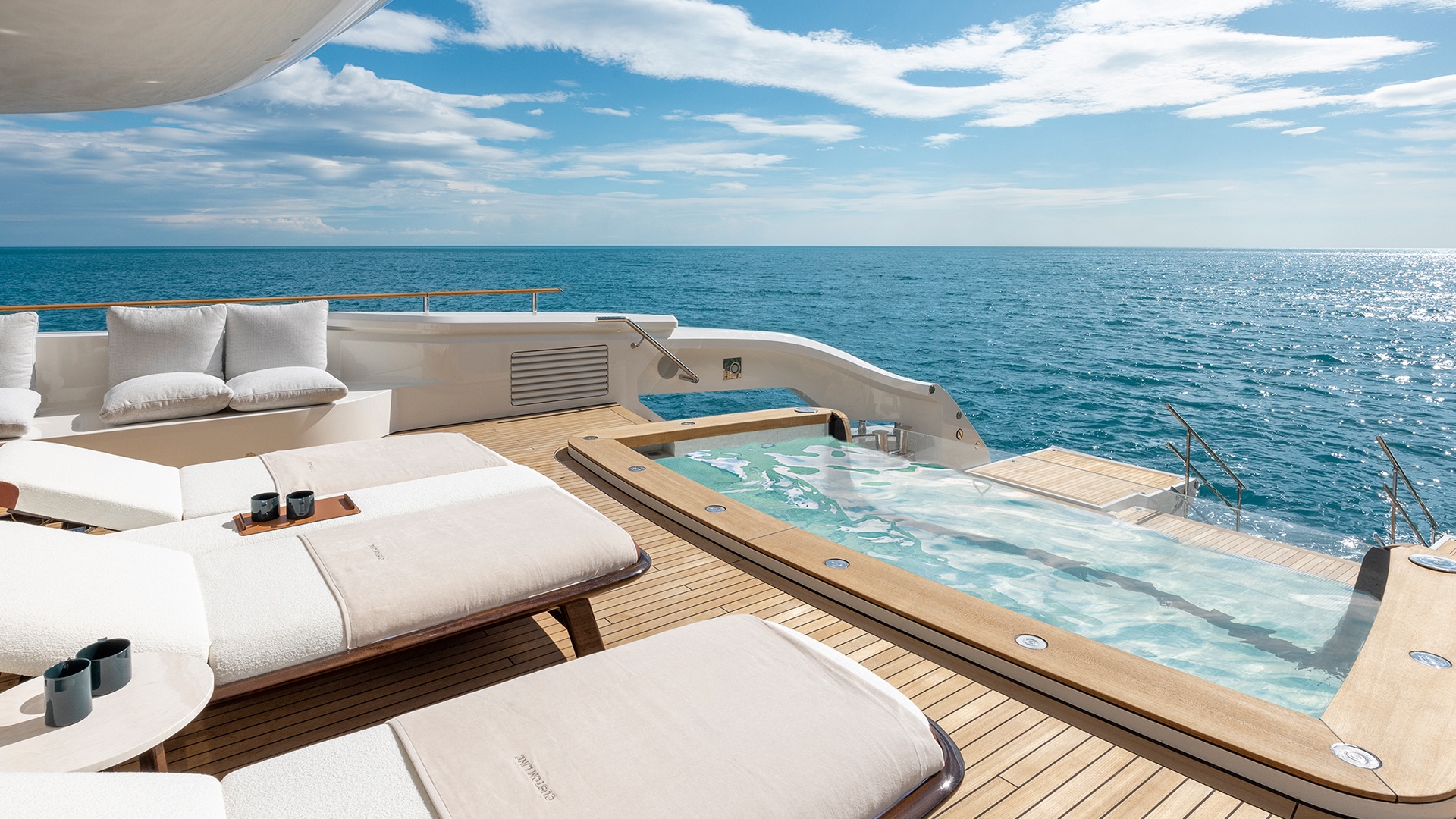 Main deck · Infinity pool
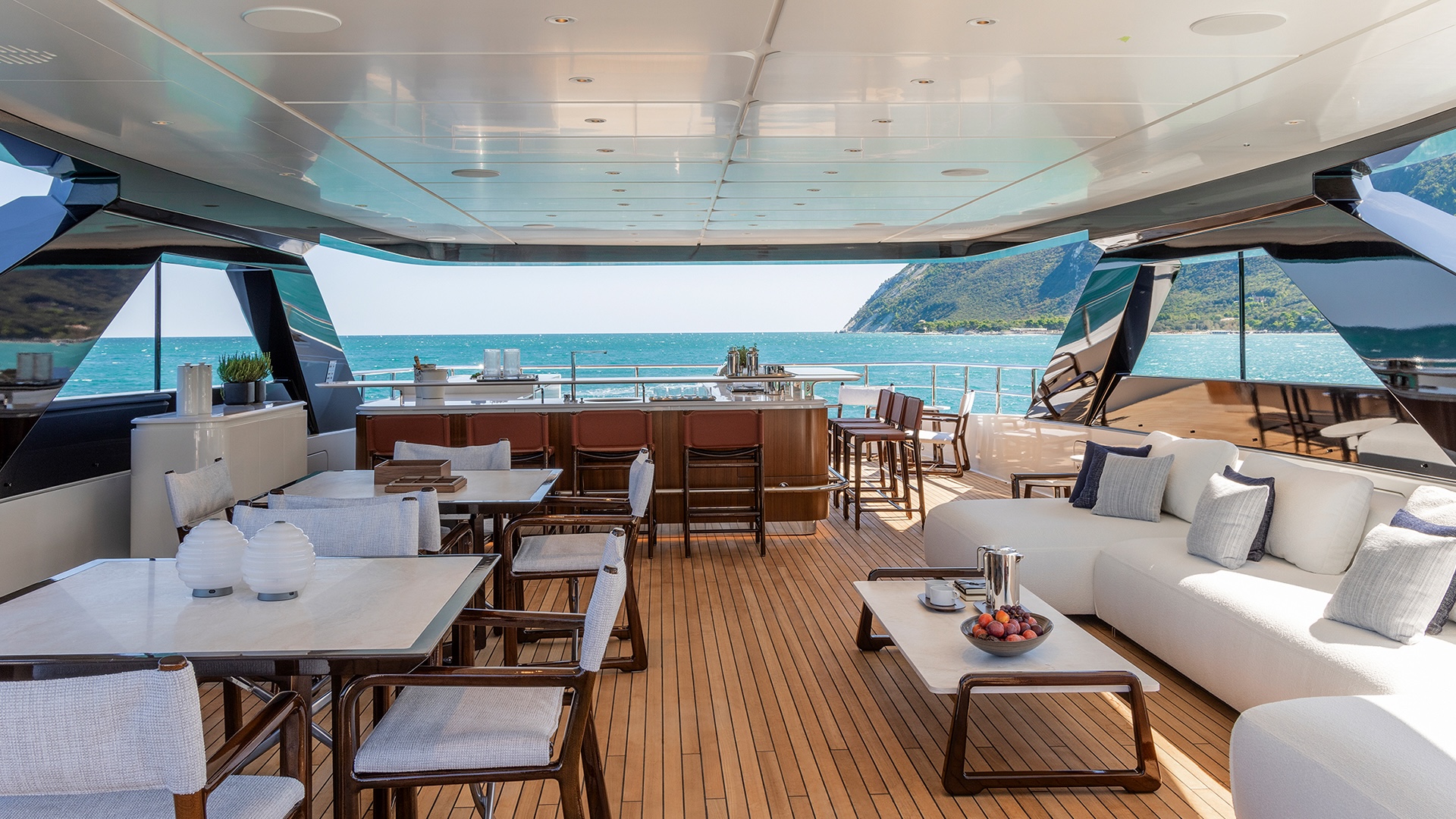 Sun deck · Lounge
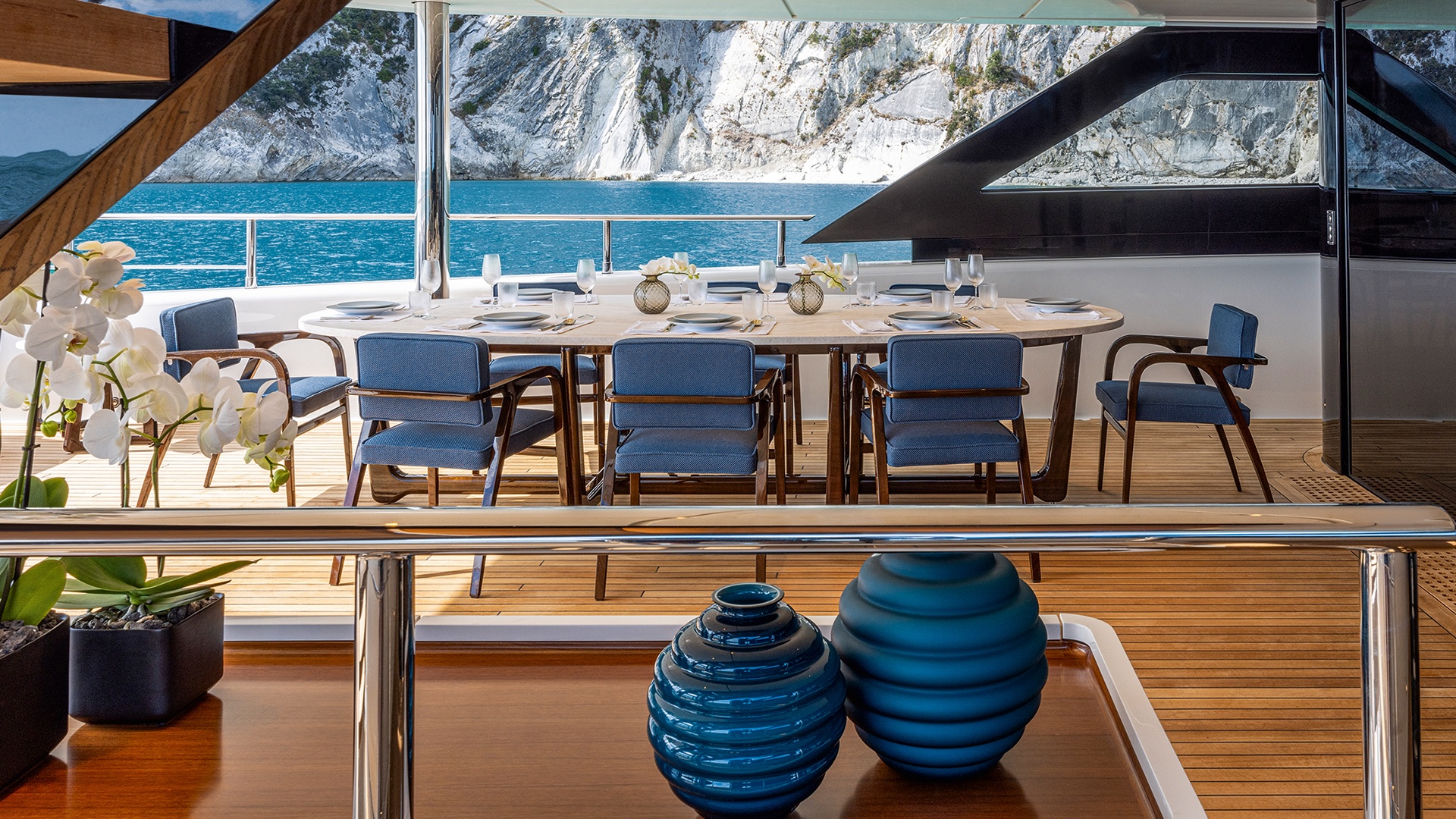 Cockpit · Al fresco dining
The exterior design lends each deck its own personality, forming a sequence of terraces that face the water at every hour of the day.
USA Onboard · After the Custom Line design statement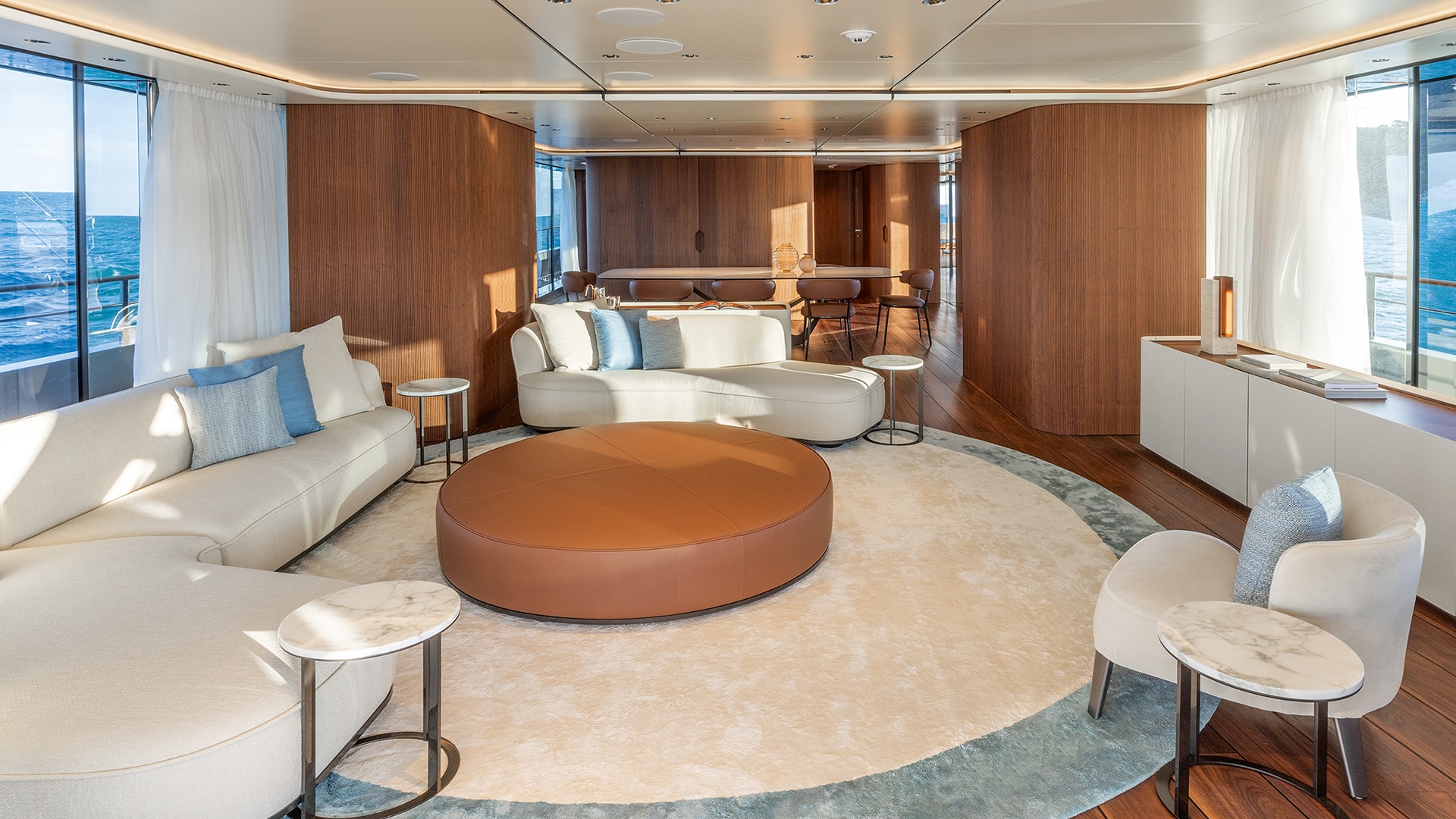 Main saloon · Hull #1 layout
A vocabulary built around walnut and natural leather
The interior of the Custom Line 50 is the work of ACPV Architects, the practice founded by Antonio Citterio and Patricia Viel, and the rooms read as a single, coherent design statement rather than a sequence of decorated spaces. The dominant tones are warm and quiet: walnut, natural leather, ivory and beige lacquering on the ceilings, light gray on furnishings and custom textured fabrics. Stone work is reserved for the bathrooms and accent surfaces, where Calacatta Oro and Crema d'Orcia marbles are inserted with the discipline of a residential project. The mood is contemporary classical, never decorative for its own sake.
The main saloon reads at the scale of a residential living room, organized around floor-to-ceiling glazing and the curved hull-side windows engineered specifically for this boat. Mirrored finishes are deployed strategically rather than as a stylistic flourish, expanding the perceived volume of the room and stretching the sightlines toward the sea. The line that separates the indoor saloon from the cockpit is, for most of the day, a notional one: the sliding glass doors run on a flush floor that erases the threshold.
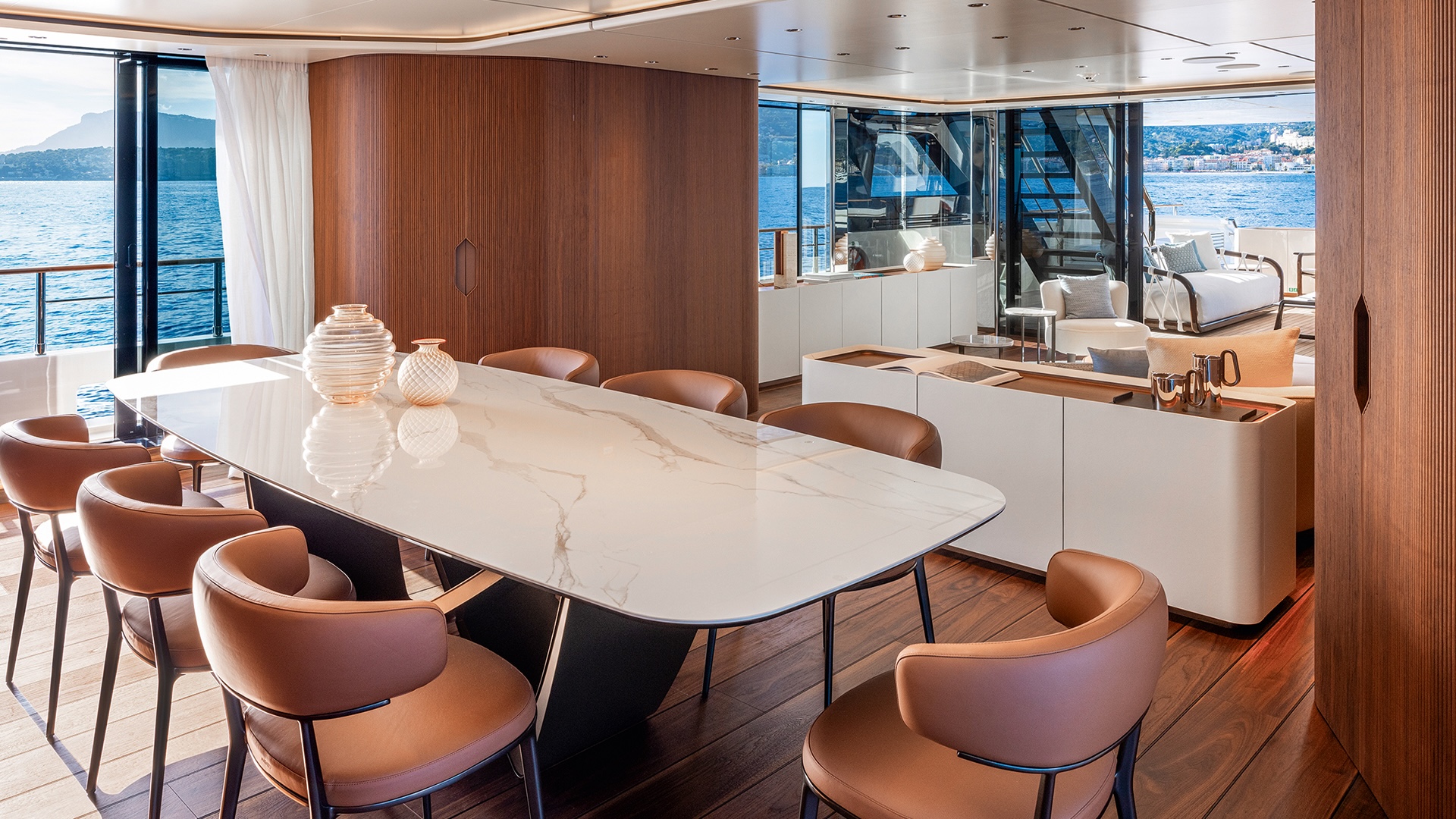 Dining area
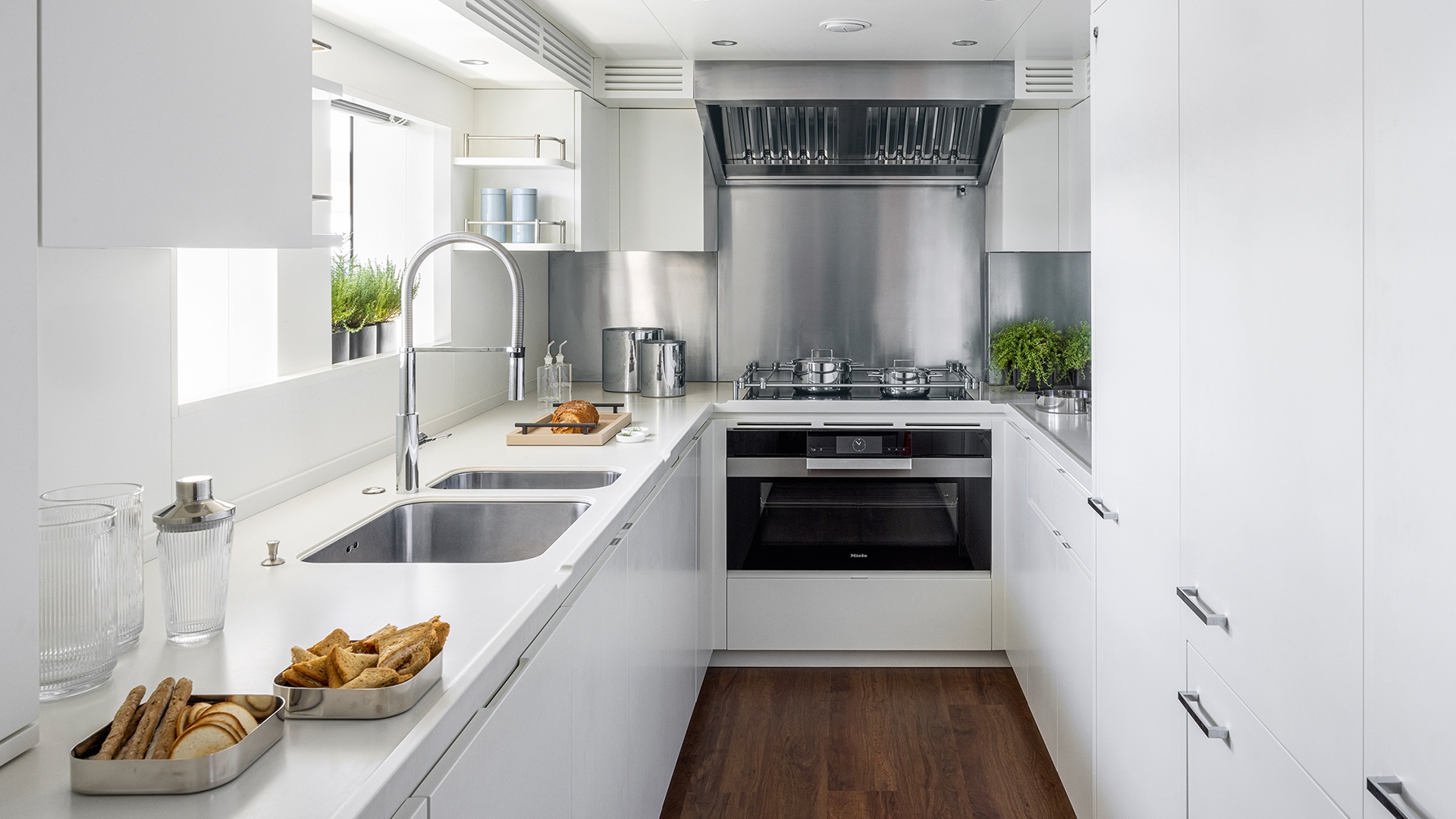 Galley
A dining room that holds the center of the day
The dining area is configured to be read first as an architectural space and second as a service zone. The table sits under a bespoke lighting moment, with chairs upholstered in natural hide and the same warm palette that runs through the saloon. ACPV's approach to the room is intentionally restrained: the volume is the gesture, not the furniture. Curved glazing along one side gives the meal an orientation, and the proximity to the galley keeps the service circuit short without making it visible from the dining position.
The galley itself is engineered as a working professional kitchen and reads in the same restrained idiom as the rest of the boat. Stainless surfaces, light flooring, integrated appliances; the room is sized for full charter service but kept visually quiet so that its presence on the deck never competes with the social spaces it supports. Behind the design lies a coherent principle: every public room on the Custom Line 50 has been calibrated to look as good empty as it does occupied.
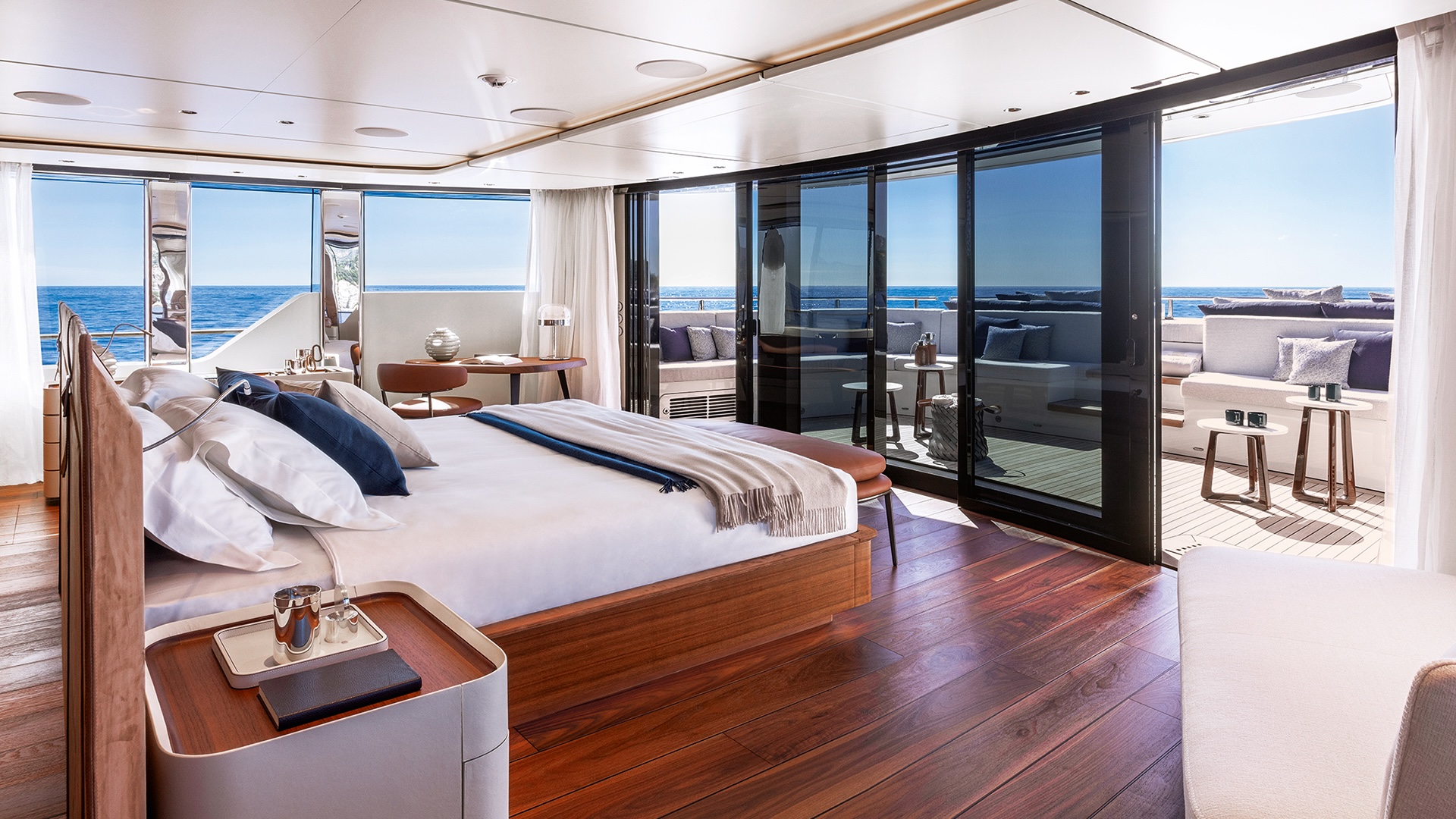 Master suite
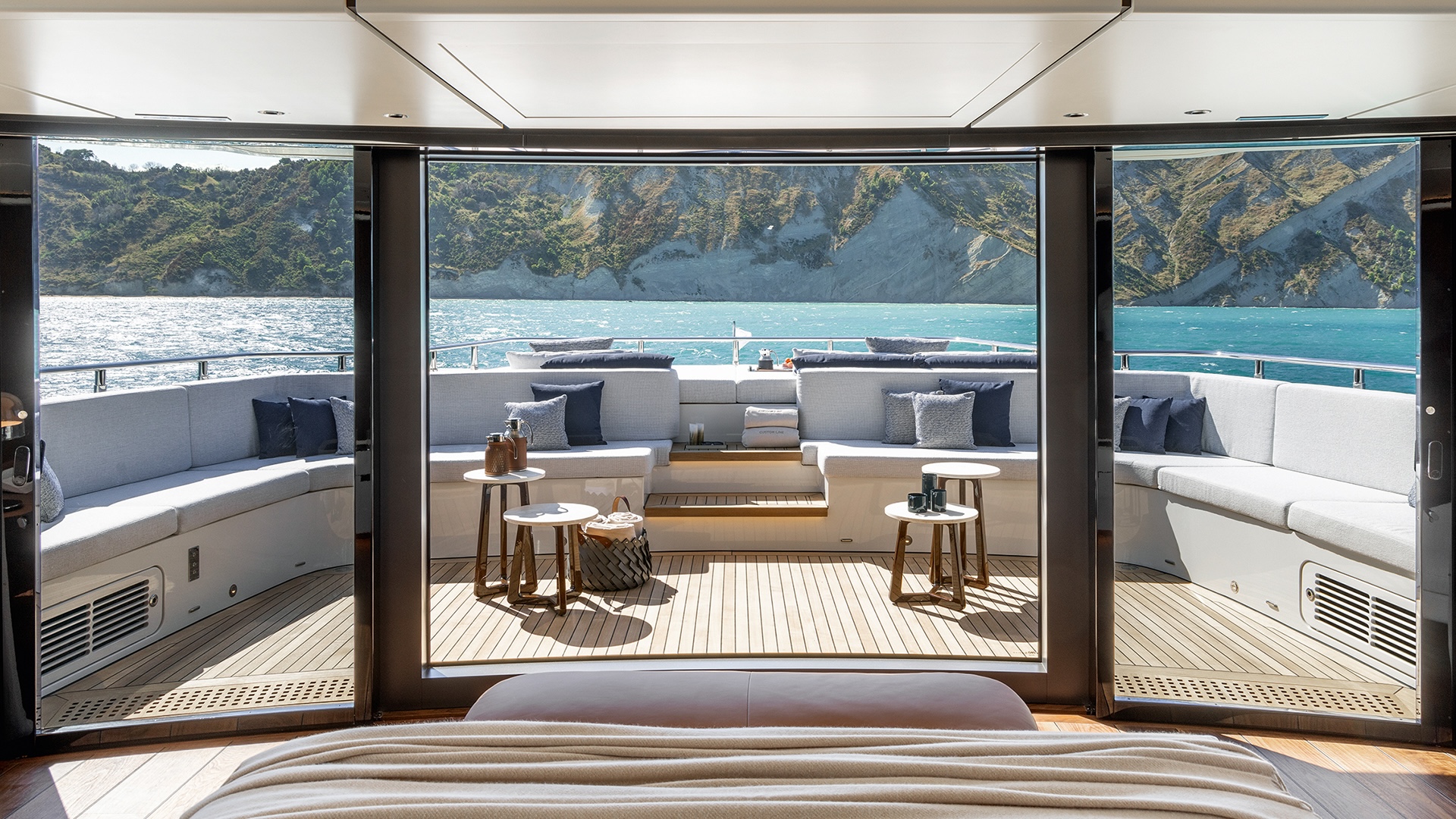 Owner's private terrace
A bow apartment built at residential scale
The owner's apartment occupies the forward portion of the upper deck and runs to roughly seventy-five square meters. The argument for this layout has less to do with floor area than with circulation. Custom Line designed the upper deck to be entered, used and crossed by the owner without intersecting the routes used by guests or crew. The result is privacy of the kind ordinarily reserved for displacement yachts above sixty meters, ported into a hull under five hundred gross tons.
The cabin itself is wrapped in floor-to-ceiling glazing that delivers a roughly 180-degree view of the seascape. The bed is positioned centrally, deliberately separating the sleeping zone from the walk-in closet, the bathrooms and the entry vestibule, so that the owner's line of sight to the horizon remains unobstructed. Double sliding doors lead, across a flush floor, to a private terrace fitted with soft seating and a sun area. The bathroom is organized as two communicating rooms connected by a generous walk-in shower, lined in marble continuous with the apartment's palette.
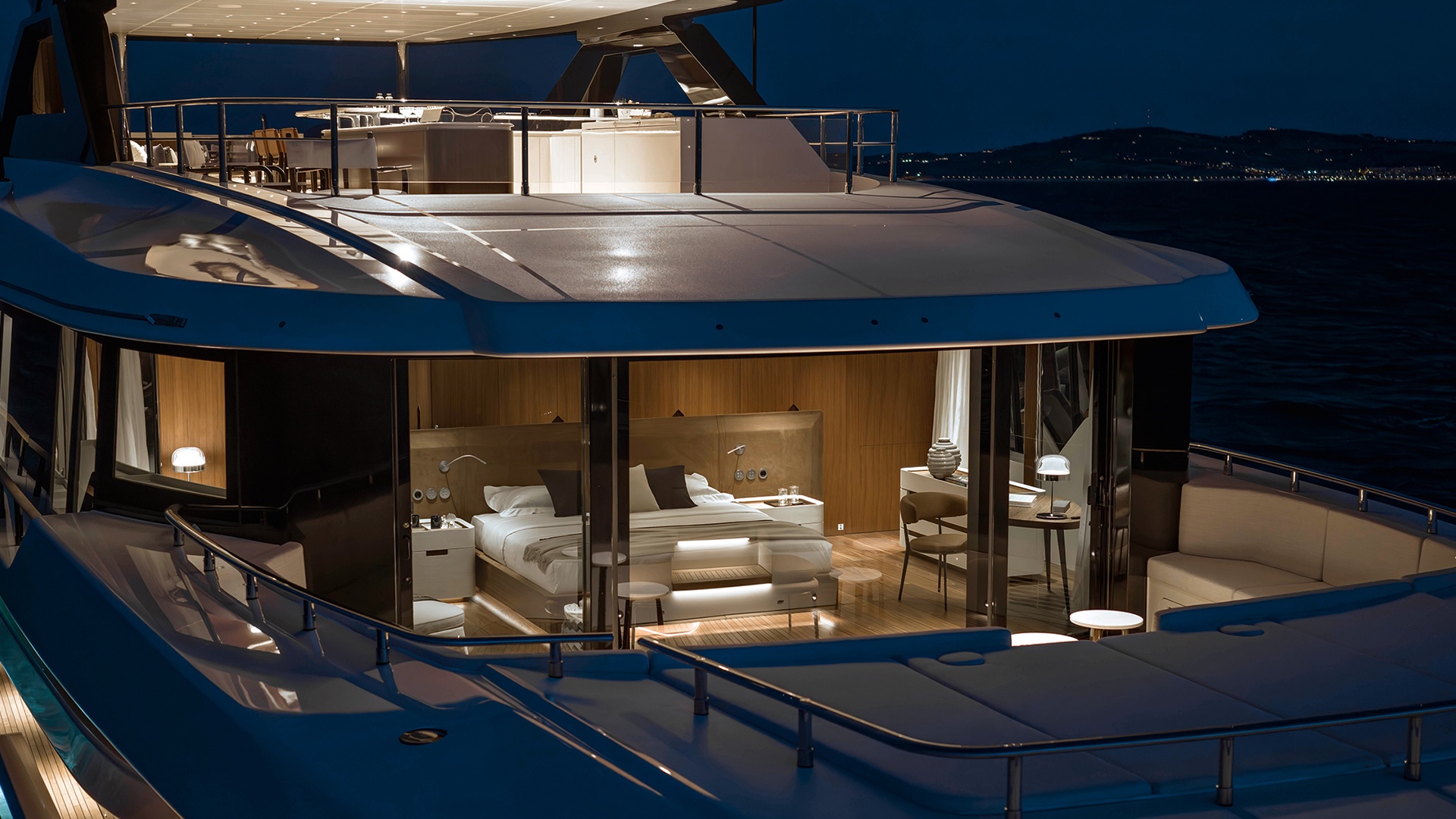 Owner's terrace · After dark
A second saloon, sized for a private evening
Aft of the owner's apartment, the upper deck holds the second saloon, a quieter and more intimate room than the main one below. The volume is anchored by the same floor-to-ceiling glazing and the same curved windows, and the indoor-outdoor continuity remains the organizing principle: open the sliding doors and the saloon merges with the upper deck terrace and the sun deck above through a vertical sequence of social spaces.
The room is configured for owner-only entertaining, the kind of evening that does not happen in the main saloon below because the main saloon is, almost by definition, the public face of the yacht. ACPV calibrated the upholstery, the lighting and the proportions of this room slightly lower and slightly warmer than the main saloon, so that the transition between the two reads as a change of register rather than a change of style. The continuity is intentional. The mood is not.